Wednesday, October 1, 2014
Don Giovanni
Don Giovanni is the legendary tale of Don Juan, a story told by many with its earliest written form attributed to Tirso de Molina, published in 1630. It has been taken on by some of the pillars of literature such as Moliere and Byron to name a few. Don Giovanni was commissioned for Prague as a result of Mozart's overwhelming popularity and was the second of three operas that the composer teamed up with librettist, Lorenzo Da Ponte. Each one of the three Italian operas focused on the relationships between the classes, the sexes, and society as a whole. On the surface, the story of Don Giovanni appears to be that of a infamous Lothario who finally gets his comeuppance, when in fact, it is much deeper and more complex than that.
The Lyric Opera's opening production of its 60th season attempted to pose these questions, confront those issues, and shake the foundation of this classic work, for better or for worse. Set in 1920's Spain, this modern production was intent on challenging preconceived notions of how Don Giovanni should be staged and ruffle the feathers of anyone who dared effrontery. Challenge accepted.
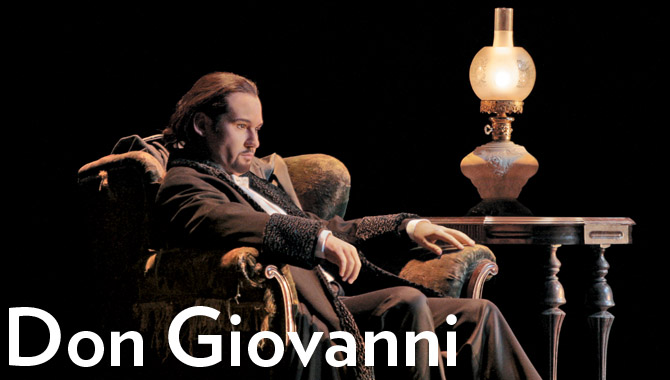
Polish baritone, Mariusz Kwiecien in one of his signature roles, sang the part of the libidinous Don Giovanni. Mr. Kwiecien has a dark and smoky lyric baritone that had no problem being heard in the cavernous space of the Civic Opera House. He sounded in healthy voice and threw himself in to the role, vocally and dramatically. It would be disingenuous of me to say that I didn't have some concerns about the casting of Mr. Kwiecien. I had only heard him sing on recording, whether it be clips from Youtube or HD telecasts from the MET. When listening to those various recordings, Mr. Kwiecien sounds a bit tenuous when it comes to singing in the passaggio, especially in sustained phrases. Upon hearing him in the role of Don Giovanni Tuesday night, my thoughts on his singing were both that of pleasant surprise and confirmation. He had more than enough stamina for the role and didn't have to oversing, although he had more than enough ability to sing forte and maintain his vocal quality. It was in the more lyric numbers where Mr. Kwiecien's underbelly was shown. In the duet, "La ci darem la mano", his voice was wobbly and lost its rich color. There were times when it sounded as though he may break. The same could be said for his Act 2 aria, "Deh vieni alla finestra". His vibrato was slower than normal and wider in the first section of the aria, which returned to normal near the end when Mr. Kwiecien sang forte with more support.
His acting was in line with the dramatic them set by the director and my only criticism would be his actions in Don Giovanni's final scene. In this production, the Don is shot in the right shoulder, yet he continues to use it unimpaired to eat, drink, and even climb an obstacle course, if you will. I thought this a bit ridiculous to say the least, but one could argue that Mr. Kwiecien had no choice given the stage direction.
As I have stated in previous blogs on Lyric Opera productions, if the title of the opera was based on the best singing, then it would most definitely be called Donna Anna. Latvian soprano, Marina Rebeka, heard last season as Violetta in Verdi's La Traviata, was once again the vocal star. Not only did she sing with a beautiful line, control, dynamics, and dramatic sensitivity, as she did in the Traviata production, but she had more of the dramatic color needed for the role of Donna Anna without sounding artificial. Her singing was fluid and agile, evident in the opening trio, "Non sperar, se non m'uccidi, Ch'io ti lasci fuggir mai!" and subsequent duet between Donna Anna and Don Ottavio, "Ah, vendicar, se il puoi, giura quel sangue ognor!". Ms. Rebeka could go from singing a beautiful listless piano, then turn on a dime to deliver a pain stricken forte with the appropriate color which was all the acting that Donna Anna requires. Much like Mr. Kwiecien, Ms. Rebeka didn't show any major signs of fatigue in her final aria, "Non mi dir", in which she sounded fluid and agile.
Upon finding my seat for the production, I decided not to read through program. I knew that Mr. Kwiecien, Ms. Rebeka, to name a few, were singing in the production, but given the fact that I admittedly had some preconceived notions, just sat back and did not remind myself of the other big names. I had totally forgotten that Ana Maria Martinez was singing the role of Donna Elvira and it wasn't until intermission that I saw her name in the program. This reminded me of how beautiful her voice was, as I didn't recognize her upon her entrance given the fact that she was dressed as a saucy red-haired Amelia Earhart. Ms. Martinez sang in Othello and Rusalka last season, both parts portraying earnest women in love, a stark contrast to Donna Elvira, a scorned woman with no where to turn. Even though Ms. Martinez has wonderful voice and sings beautifully, she did have obvious trouble with the fioritura in the Act 1 quartet, "Non ti fidar, o misera" and similar fast moving passages. What I took umbrage with in regard to the performance of Ms. Martinez was her histrionic reactions and indulgent movements when interpreting strong emotion. At one point, I half-expected Donna Elvira and Don Giovanni to begin wrestling at the side of the stage during the aforementioned quartet. The character of Donna Elvira is emotionally brittle and forlorn, but not in a state of constant tremors.
The part of Don Giovanni's conflicted assistant, Leporello, was sung by American bass-baritone, Kyle Ketelsen. Mr. Ketelsen sang the role of Don Basilio in last year's production of The Barber of Seville at the Lyric Opera, in which I thought him miscast, not because of his singing or performance, but rather the fact that his voice is more baritone than bass and as such did not carry the heft for the role. His voice and demeanor is perfectly suited for that of Leporello. He not only stood out vocally among the male cast members, but in acting as well. He was relaxed and confident in his characterization and like Ms. Rebeka, used his voice to impart the interpretation rather than his limbs. Mr. Ketelsen didn't let the demanding stage direction to get in the way of his singing which put me at ease after hearing Leporello's opening aria, "Notte e giorno faticar", sung rather than barked.
The part of Don Ottavio, Donna Anna's fiance, was sung by Italian tenor, Antonio Poli. I had heard Mr. Poli last season in the Lyric's production of Othello in the role of Cassio. In the blog review for that production I had noted that Mr. Poli sang beautifully and was glad to see that he may call Chicago a second performance home given his connection to Maestro Riccardo Muti. I was disappointed by his singing in the role of Don Ottavio. Last season his voice sounded fresh and bright with what seemed to be an easy production. On Tuesday night Mr. Poli's voice sounded tired and tight. His vibrato was wide and the upper part of his range was a bit strident and pushed. I hope that this was only an off night and he bounces back to the fresh sounding lyric tenor that he is.
Canadian soprano and Ryan Center alumna, Andriana Chuchman made her role debut as Zerlina. Ms. Chuchman has a bright lyrical sound that typifies the naïve and inexperienced Zerlina. She consistently sang with a line which brought out the bright color of her voice. At times her singing could be a bit disconnected, but she was required to be rolling around and moving quite a bit in this production.
Zerlina's fiancé, Masetto was sung by American bass-baritone, Michael Sumuel. I really enjoyed Mr. Sumuel's singing and paranoid performance. He has a rich sound with a tight vibrato that carried through the hall in a beautiful line. Mr. Sumuel brought out the emotion and fury of Masetto without coming off his voice. His bass-baritone sounds more lyrical at this point in his career which may very well darken as time goes on.
The role of Il Commendatore was sung by well known Italian bass, Andrea Silvestrelli. At his best, Mr. Silvestrelli has a cavernous voice that sounds as if it could carry on for ever and reach the depths of a bottomless pit, but he didn't seem to be at his best. His vibrato was a bit wide at times and overall his voice sounds gravelly. It can still carry all the way to the back of the hall even when competing with a full orchestra playing forte, but the consistent beauty no longer seems to be there.
Sir Andrew Davis conducted the orchestra which sounded top notch as usual. I was happy not to complain about the orchestra covering up the singers which seemed to be a recurring theme last season, but most all of the voices were big enough to carry over the smaller sized orchestra of late 18th century opera compared to that of the later 19th century. I thoroughly enjoyed the opening overture which the orchestra played in a crisp and clean manner. Sir Andrew Davis took the final scene with Don Giovanni a bit fast for my taste, but I didn't complain under the circumstances of this production.
The set design by Walt Spangler set in 1920's Spain was simple, yet classically elegant with depth and character. The stucco and marble architecture provided a wonderful background for the colors of each scene that pervaded the story. The clean design helped to support the rich and at times beautifully decadent costumes designed by Ana Kuzmanic. They ranged from period 1920's signature clothing, to classic formal wear, down to traditional Spanish dresses with untraditional design which made those characters stand out in a crowd.
Multiple award winner and Artistic Director of Chicago's Goodman Theater, Robert Falls is at the helm of stage direction for Don Giovanni. In the director notes of the program, Mr. Falls explains the reasoning behind setting Don Giovanni in 1920's Spain.
"...I wanted to introduce a 20th century sensibility and psychology to the piece...I should emphasize that the result is not a documentary about the 1920's, but rather a highly theatricalized world that uses the 1920's as a point of reference."
Mr. Falls also explains in those opera notes that when taking on a production of Don Giovanni, a director has to try and answer dozens of questions posed by the open-ended and mysterious work, which I wholeheartedly agree with. Suffice it to say, there are layers upon layers of themes and questions that are ultimately posed to the audience to ponder, especially in light of Giovanni's descent in to hell. One of the constant struggles for the Opera world is to keep timeless works, such as Don Giovanni, fresh and relevant. A popular attempt at that by Opera companies and Directors alike have been updating the setting to modern time periods. I applaud Mr. Falls' strong artistic vision which does, in my humble opinion, steer off the beaten track of the classic productions of Don Giovanni, with regard to inner compass of Don Giovanni himself.
Mr. Falls makes the Don out to be a perpetually drunk, drug sniffing, sex addicted, sociopathic, misogynistic, serial-rapist, control freak who may very well be willing to crash a plane he's flying if given the chance to bang a passenger. This angle, however courageous and unwavering, did not work for me, not because I am unwilling to break out of the mold of the classic setting of this work (or any other opera for that matter), but I felt Mr. Falls betrayed the underlying message and/or question of the piece by focusing on the spectacle of his vision. As Mr. Falls relates in one of the Lyric Opera's interviews that can be located on its You Tube channel, Don Giovanni is not a "nice guy". Mr Falls goes on to explain in that interview that Don Giovanni can be viewed as an "anti-hero" who you root for even though he does evil things at times. I agree with that explanation, but I would say that that was not achieved in this production of Don Giovanni. At no time was I rooting for the main character, nor did I believe that the women of this work, save for Donna Elvira, would either get involved with him or have any desire to stay given the fact that he was constantly abusing and demeaning most all of the women according to Mr. Falls' artistic direction. His consistent manhandling and mocking of his conquests not only made the character flat and one-sided, but also made the female characters, big and small, out to be willing punching bags for him.
After a while the Don's behavior became monotonous and mean. The "highly theatricalized" direction that Mr. Falls took was disjointed and resembled a collage of pictures cut from various magazines and glued together unwilling to hide the seams. I got the impression that Mr. Falls' vision of Don Giovanni was based on Tony Montana from the movie Scarface transported back to the roaring 20's alongside obviously modern movie references such as an interpolated orgy scene taken from Stanley Kubrick's, Eyes Wide Shut, complete with masks and ménage-a-trois. The sensationalistic behavior, whether it be snorting cocaine off women's breast, street side oral sex, or a half-naked woman chained to the wall with visible bruises received at the hands of the Don, are just a few of the examples of how this production's focus was on shock and spectacle rather than story and singing.
The saving grace of this production, which was most definitely a close one, is the singing and musical drama of Mozart and Da Ponte. For the inexperienced opera goer or novice, I would say to go if given the chance, but for the opera enthusiast, I think this is a prime example of how Opera is being dumbed down to a visual medium rather than the aural amazement that it can be. From the orchestral reference to the aria, "Non piu andrai" being piped through speakers made to sound like a radio to the Commendatore's voice being artificially amplified for spooky effect, these small steps are unfortunately breaking away the cornerstone of what Opera is in order to attract younger audiences unaware of this dismantling.
Labels:
Ana Maria Martinez,
Andrea Silvestelli,
Andriana Chuchman,
Antonio Poli,
Chicago,
Don Giovanni,
Kyle Ketelsen,
Lyric opera of Chicago,
Marina Rebeka,
Mariusz Kwiecien,
Michael Sumuel.,
Mozart,
Robert Falls
Thursday, February 20, 2014
The Barber of Seville
As is the case with so many dramas, the histrionic storyline on stage can sometimes be overshadowed by the melodramatic happenings outside. So is was with Rossini's, "The Barber of Seville". As noted in the Lyric Opera program notes, Rossini faced an angry set of sycophants at the premiere. The Italian claque were in attendance to not only show their unpleasant reaction to Rossini's opera, but to voice their support for the composer, Giovanni Paisiello who had originally set Beaumarchais' story to music. The first "Barber of Seville" had its premier in 1782 and was considered a mainstay on the operatic stage up to that time. After the disastrous 1816 premiere, like most comic operas, Rossini won out in the end and his version of "The Barber of Seville" is the true main stay nearly 200 years later. This opera holds special memories for me, most of all being that this was the first production that I heard at the Lyric Opera of Chicago back in 1994, with Rockwell Blake as Count Almaviva.
The title may be The Barber of Seville, but judging by the individual performances of this production, I would have to change that to "Rosina's Revenge". American Mezzo-Soprano, Isabel Leonard made her Lyric Opera debut with a vocal splash as the servile, yet spirited Rosina. Her dark round tone was sung in a beautifully connected line that bloomed, like her characterization, as her voice eased through every part of its range. Ms. Leonard used her impeccable technique to bring out the subtle nuances of Rosina's personality in the aria, "Una voce poca fa", which conveys the true character beneath her outward obedience and charm. Ms. Leonard's voice has a dark polish in the lower range which is a wonderful contrast to the light airy colors that she can employ throughout the middle and upper parts of her voice with ease in Rossini's florid sections. That is not to say that those areas of her voice are light or small. Ms. Leonard had no problem being heard, as evident in the Act II finale when Ms. Leonard is one of two female singers onstage next to 5 male soloists and all male chorus. Both female parts had no trouble carrying past the overwhelming sound of orchestra and men. In addition to the beautiful singing and interpretation, Ms. Leonard's acting was one of the few highlights in an otherwise frenetic staging. The only flaw was near the end of the opera when her vibrato sounded a bit wide, which was understandable given how much singing is required for the role of Rosina.
The part of Count Almaviva was sung by the young American Tenor, Alek Shrader, who was prominently featured in the operatic documentary, The Audition. Mr. Shrader has quickly made a name for himself as a Rossini/Mozart specialist on the international circuit. He has a sweet and agile voice that has little to no problem executing the long passages of fioritura in every area of his vocal range. That's not to say that his singing was perfect with regard to stylistic choices. Mr. Shrader crooned throughout his first aria, "Ecco ridente..." and employed straight tone, especially when moving in to his higher register. This stripped some of the color from the voice and broke up the Bel Canto line, but because of the innate beauty in his tone, most audiences will accept this method without question. Another bit of collateral damage was Mr. Shrader's projection. His voice was difficult to hear at times even when the orchestral dynamics were piano. Mr. Shrader's singing, however naturally beautiful, was inconsistent and veering dangerously close to a pop-like sound. When Mr. Shrader sang with support and core, his voice projected more easily and suddenly had more depth. With regard to his stage presence, he was quite confident in the characterization of Almaviva, but moved too much around the stage. Even when he just stood and sang, there were too many hand gestures and I'm quite sure that he did an Elvis pose at one point.
Figaro himself was sung by well known American Baritone, Nathan Gunn who is experienced not only in opera, but classic American Musical theater as well. Mr. Gunn has a warm and well rounded tone that is hard not to like, which is basically what I was thinking whenever he sang.
"I want to like him."
It was apparent from his opening cavatina, the ever popular "Largo al Factotum", that the role of Figaro was not necessarily going to be a walk in the park for him. Although Mr. Gunn's voice was a bit bigger than Mr. Shrader's, he had difficulty maintaining his quality of tone throughout the high tessitura of Figaro's opening aria. Mr. Gunn's vibrato was consistently wobbly and uneven throughout the entire opera. It was difficult to pick out his voice in larger ensemble numbers, especially against an orchestral forte. Despite his round and velvety tone, I wonder if Mr. Gunn hasn't inadvertently neglected his operatic technique in pursuit of theatrical interpretations.
In our new title, "Rosina's Revenge", the later would be in reference to the "other" star of this production, word renowned Italian Baritone, Alessandro Corbelli who sang the part of the scheming Dr. Bartolo. I would say that he was the only one of the men to consistently sing with a line. He didn't bark his way through the role, as we have come to expect with it being a slapstick comedy part. I also have to say that it was such a breath of fresh air to hear Signor Corbelli use glottal fry to in order to keep his voice grounded through the fast moving parts that sat in a higher place of his range. This is fast becoming a dying art, which from a technical perspective is a necessity for one who wishes to have a long lasting career in opera. Just ask Mr. Corbelli, who has been singing since the early 70's. In addition to his fine singing, Mr. Corbelli nailed the uptight, highly strung, and effusive nature that is Bartolo.
American Bass-Baritone, Kyle Ketelsen sang the role of Don Basilio. Without any intention of disparaging Mr. Ketelsen's performance, I felt that he was totally miscast in this role. He has a rich dark tone that carried throughout the hall, but it is not the color that is needed for the role. His timbre was far too similar to that of Mr. Corbelli rather than that of a true bass which brings out the texture that Rossini's score calls for. There were times that I felt that Mr. Ketelsen was trying to artificially darken his voice during Basilio's grand aria, "La Calumnia". The casting of a Bass-baritone rather than a Bass was not to my liking which is once again, nothing to do with Mr. Ketelsen.
The comprimario roles were filled out with three singers from the Lyric's Ryan Center young artist program. American Baritone, Will Liverman sang the beginning role of Fiorello, which he sang with rich tone and a connected line. Baritone, John Irvin sang well as the Sergeant, but the surprising stand out of the three, in my opinion, was Soprano, Tracy Cantin in the role of Berta. She has a big bright sound that easily carried along side Ms. Leonard in the male heavy Act II finale. The only criticism I had of Ms. Cantin's singing was that during her aria, it sounded as if she was trying to brighten the tone which took away some of the beautiful depth of sound that he voice is capable of.
Leading the orchestra was Italian conductor, Michele Mariotti, making his Lyric Opera debut. Maestro Mariotti did a wonderful job of adhering to the range of dynamics of the score, although I felt that he took many of the tempi too fast, especially those of the consonant heavy "patter" numbers. There were a few moments that I thought Mr. Corbelli was going to pass out due to lack of oxygen. If the tempi had been a tad slower, the singers would not only have a chance for a full breath, but we could hear the pitches more clearly rather than escaping air of endless consonants.
Making his Lyric Opera directorial debut is Rob Ashford, who recently directed "The Sound of Music" which appeared live on TV. Ashford's stage directions seemed overdone with bits of minutia that either missed or caused distraction both visually and aurally. At the start of the opera, the village orchestra players shuffle around the stage which took away from the music. Ashford had Count Almaviva moving around in apparent romantic sturm und drang as he sang his opening aria, at some points with his back to the audience and downstage, which made it challenging for the audience to hear the music clearly. As I stated before, Alek Shrader who sang the role of Almaviva was in constant motion even when standing still. I think this emphasis on the visual in an aural medium is no aberration, but a disconcerting philosophy that stage directors are allowed to pursue with little restraint or balance. I felt that the overall stage direction was a distraction from what I came to hear.
Both the orchestra and chorus (overwhelmingly male) sounded wonderful with a special nod to the string players who executed the tempi and ever changing dynamic levels with precision.
The set design was by Scott Pask, also making his Lyric Opera debut. I thought it was beautifully elegant, employing a clean looking 18th century Spanish style hacienda villa decorated with a real fountain in the midst of an open courtyard. My only criticsm was the abnormally long amount of time the set change took in between the first 2 scenes, although it was executed in an artistic manner.
Monday, January 27, 2014
Die Fledermaus
First off, let me apologize for my partially unexcused absence from posting my blog. I planned on composing my review of the Chicago Lyric Opera production of Die Fledermaus right after Christmas, but I became lazy as a result of the polar vortex that froze my mind and fed my procrastination. I will endeavor not to disappoint the throngs of readers that encompass my fan base.
With that, I attended the opening night production of Die Fledermaus and had listened to a few different productions of it in order to reacquaint myself with the goings on. I was especially fond of the 1990 Covent Garden production with Nancy Gustafson in the role of Rosalinde.
The operetta, Die Fledermaus, composed by Johann Strauss II, had its premiere in the spring of 1874 at the Theater an der Wien. Although the plot of Die Fledermaus is a bit convoluted, it surrounds the personal intrigues of a handful of individuals looking to have a good time at a Russian aristocrat's costume ball, consisting of a husband with a 7 year itch, his devoted wife, their scheming maid, a friend with a grudge, the local prison governor, the wife's ex-lover, a bored Russian Prince, a drunken jailer, and load of party guests, all arranged for the sole purpose of exacting revenge. Gabriel von Eisenstein has been ordered to jail for 8 days as a result of being held in contempt of court over a misdemeanor and his friend, Dr. Falke, sees an opportunity to get back at him for a prank that Eisenstein had pulled a few years earlier. Falke enlists the aid of Prince Orlovsky, who demands amusement, to strike at Eisenstein before his jail sentence. Adele, the Eisenstein's maid. is invited through her sister to the costume ball and claims that she needs leave to visit her dying aunt in order to attend the party. As one could imagine, the well spun lies of the attending party guests become interwoven and in spite of the plot holes that resemble I-94 after a long winter, the seemingly lost cause of all is resolved at the night's end, where it should have started. The Jail. In addition to the light hearted fun of Die Fledermaus, the operetta has a flexibility in the specific aspects of the action that help to keep the work fresh and new, which is vital for any production to remain in the standard repertoire.
The part of Gabriel von Eisenstein was sung by internationally renowned lyric baritone, Bo Skovhus. From his first entrance to the final curtain, Mr. Skovhus looked and sounded as if he was having a great time. No stranger to operetta, Mr. Skovhus' voice was ideally suited for the high tessitura of Eisenstein, a part that is sometimes sung by a tenor. He had little trouble singing in the upper part of his register and was one of the few singers who could be heard with little exception. Mr. Skovhus has a unique sounding lyric baritone voice that is tenorial in color with a slight silvery edge to it. He was full of energy and seemed to take delight in the giddy nature of the production. A critique of his performance would be that it was a bit one sided in that he was constantly shuffling around like a Heidelberg university student with his mates in a bierstube.
The part of Rosalinde in her American opera debut was German soprano, Juliane Banse. Ms.Banse's round and dusky soprano projected in to the large space of the Civic Opera House, but sounded strained and held in the top of her range which, in addition to being unpleasant, stripped the color from the sound. Ms. Banse's rich and rounded voice was nicely suited for her aria, "Klange der Heimat", in which her character is disguised as a Hungarian Countess. Her acting was a bit stiff, but in her defense, Die Fledermaus is not a character study or a psychological drama. There's not much to develop for the singers and are relegated to playing archetypes ornamented with shtick.
Also making her American debut in the part of the Eisenstein's house maid, Adele was sung by Austrian soprano, Daniela Fally. Ms. Fally has had plenty of experience in this role, evident not only in how natural she was in mugging for the audience, but how comfortable she was singing while moving around the stage. It was as if the role was written for her with the obvious highlight being that of "Adele's laughing song" in the 2nd act, which was a triumph. My overall disappointment with her, was not in any way her performance, but the size of her voice in so large a theater. It was hard to pick out while singing with the ensemble or having to project over the entire orchestra. Like her acting, I missed the color and dynamics of her voice because, once again, the Civic Opera House is so large and forces singers like Ms. Fally to abandon their musicality just to be heard.
The part of the foil, Dr. Falke was sung by Austrian Baritone, Adrian Eröd making his Lyric Opera debut. I was quite disappointed by his performance, both in singing and acting. I found the innate sound of his voice to be bland and he didn't sing with much musicality. He seemed to be of little energy throughout the production, especially in the 2nd act canon, " Brüderlein und Schwesterlein", which features the part of Dr. Falke. The staging of it did not help, as Mr. Eröd stood center stage with Adele's sister at his side. Each time he asked her for a kiss, I felt as though I had been given a glass of flat champagne.
The daunting part of Alfred, the tenor who longs to romance his ex-lover, Rosalinde, was sung by Michael Spyres, who sounded as if he had no trouble jumping from interpolated high note to high note. Again, the character of Alfred does not require much acting skill, but Mr. Spyres was quite funny and didn't pile it on too much. Listening to him got me to thinking why those in charge of casting did not have him sing the role of the Duke in Rigoletto last season, instead of the tenor who cracked 2 times in his first aria alone.
Frank, the prison governor was sung by British baritone, Andrew Shore who was well suited for the part of the jovial middle aged man, searching for a little extra fun. Mr. Shore had no problem being heard and while many singers in this role tend to bark their way through the piece, he sang with line when it was called for and switched to a Rossinian patter in the faster sprech-stimme parts. Mr Shore was the best at inhabiting the rotund character of Frank and much like his singing, employing varying dynamics and colors without overdoing it.
The trouser part of Prince Orlofsky was sung by Mezzo Soprano, Emily Fons. After hearing a recording of this role being sung by a countertenor, I much more prefer it to be sung by a mezzo soprano, especially one with the dark color and warmth of Ms. Fons. She was faithful to the staid character of Prince Orlofsky which helped to create a nice counterbalance to the energetic Eisenstein. Ms. Fons' voice was perfect in the aria, "Chacun a son gout".
The remaining comprmario roles were sung admirably, given the little content that had been written for them. Ryan Center alumni, tenor David Cangelosi, sang the Basilio like role of Dr. Blind nicely. My one wish which has yet to be fulfilled is to hear Soprano and current Ryan Center member, Julie Anne Miller sing a substantial role and unfortunately, her only singing was in ensemble moments.
The orchestra and chorus sounded wonderful and although it was difficult to hear some of the main singers, I don't think that there was much that conductor, Ward Stare could have done given the type of production this was. The sets were very nice for the setting as well as the choice of having dancers during the 2nd Act party scene rather than the common option of having A-list guest singers come in to sing arias and duets. If I had my druthers, it would have been to switch the dialogue from German to English. I know that most all of the main singers are native German speakers, but the recurring problem throughout the performance was that the punch lines were projected for the audience to read before the performers spoke them which took away from the action on stage. For that reason, I think it would be better to have the dialogue spoken in the language of the audience who is listening.
All in all, the performance was quite enjoyable and a nice change of tune from the heavy productions that had come before this season.
Labels:
Bo Skovhus,
Chicago,
Civic opera house,
Daniela Fally,
Die Fledermaus,
Johann Strauss,
Lyric opera of Chicago,
Opera,
Opera review,
Ryan Center,
Ward Stare.
Thursday, December 5, 2013
La Traviata
Soon after it's disastrous premiere in 1853, La Traviata became one of the most widely performed operas in the standard repertoire and with Verdi's 200th Birthday this year it is the #1 performed opera in the world for the 2013-2014 season. Beyond the obvious appeal of Verdi's melodies, Alexandre Dumas' story of heartbreak, and the classic tale of redemption, is the integral theme of women's role in society. The Lyric Opera of Chicago had the chance to say something that is both culturally pertinent and dramatically artistic with their latest production of La Traviata running through December 20th. Unfortunately that did not come to fruition as I hoped given the many skips and squeaky wheels that kept the performance from achieving that end.
La Traviata is the story of a beautiful courtesan named Violetta Valery who, the audience will soon learn, is dying of consumption. She is a kept woman of the wealthy Baron Douphol and enjoys her role as high society party goer which helps draw her attention away from the sad inevitably that she will be confronted with in the near future. Violetta is introduced to a young admirer named Alfredo Germont who has pined for her from afar. He quickly declares his love and is met with frivolous laughter on the part of Violetta. He continues to shower her with affection to which she soon becomes infected by. As dawn approaches he and the other party hoppers leave and Violetta faces off against her own fears of love, life, and death.
Time passes and we see Violetta in love with Alfredo and with life looking to the future. Love is quickly interrupted by Alfredo's father who pleads with the sickly courtesan to leave his son for the sake of their family honor. She finally gives in to Germont Pere and accepts her plight of the fallen woman unable to attain happiness. Alfredo thinks her unfaithful and seeks revenge at a party Violetta is to attend along with her former lover, Baron Douphol. Alfredo lucky in cards yet unlucky in love, humiliates her and in his embarrassment flees the party. The final act takes us back to Violetta's room where she lays in wait for either Alfredo or death, which ever is to arrive first. Alfredo makes it in time accompanied by his guilt stricken father with barely enough time to refresh their mutual love before she succumbs.
The part of Violetta Valery was beautifully sung by the radiant Latvian lyric soprano, Marina Rebeka in her Lyric Opera debut. She sang with a great range of dynamics without breaking the melodic line, ever so important to Verdi's music. Ms. Rebeka easily projected in to the large civic opera house and sounded in wonderful voice as she easily danced her way through the vocal acrobatics of the psychologically conflicted recitative and aria, "Ah, fors'è lui - Sempre libera". Her stage movement was fluid and uninhibited during the more vocally challenging parts of the role, yet at times stale and stiff in the more dramatic acting moments act 2.
Ms. Rebeka was still vocally fresh sounding at the beginning of act 3, but did show signs of fatigue near the end, which I can not blame her for given the difficulty of Violetta and the endurance required to sing it.
Alfredo Germont was sung buy international tenor, Joseph Calleja who was last heard at the Lyric in the role of Rodolfo. There are two things I should admit with respect to my thoughts on Mr. Calleja. I had heard him in La Boheme last season opposite Anna Netrebko and I was not impressed. During that performance he sounded tired which became more evident with each one of his entrances to the point where his vibrato was wide and his tone shallow and brittle. His performance of Alfredo was much better than that of his Rodolfo. My second admission is that I am not an ardent fan of his voice. Many critics describe it as a throwback to the golden era of opera with his tight squillo vibrato and bright tone, but there seems to be an ever present edge that robs it of its depth. Mr. Calleja sounded a bit tight at the beginning of the performance, but slowly warmed up as the night went on. Unfortunately it wasn't until the last act that he sounded his best. To be fair, he sang with sensitivity and dynamic variation and was in good voice from top to bottom, but consistently clipped off the ends of musical phrases which gave the impression that he was anticipating the breath too quickly. His acting was stiff, a theme shared by most all of the players. Mr. Calleja consistently dashed off stage during his exits as if the character had pressing matters in town that required his immediate attention, or taxi carriages were in short supply in Paris during the mid 19th century.
The part of Alfredo's father, Giorgio Germont, was sung by baritone and Ryan Center alumni, Quinn Kelsey, whose performance I thoroughly enjoyed in last season's Simon Boccanegra. Mr. Kelsey has become an internationally renowned Verdi baritone with his beautifully rounded and dusky tone. Mr. Kelsey's voice is nicely connected with an easy sounding upper register which has no problem projecting in to the house, yet maintains its sweetness. Still, I was disappointed by how Mr. Kelsey chose to sing much of his showcasing moments, such as the famous act 2 aria, "Di Provenza il Mar, il suol", with a Verdian sprech stimme making him sound choppy and disconnected. Although this stylistic choice may give the audience an aural appearance of an older man, it robs the singer of color and depth of sound which, in my humble opinion is needed in a part like Germont. Mr. Kelsey's dramatic interpretation was quite one sided and brutish, as if Alfredo's father was not an educated Parisian, but a disciple of Russian Tsar, Peter the Great. Given the consistency of placid acting evident in the absence of sensitivity towards a humiliated and dying woman, one has to question if this shortcoming is the responsibility of the performers or an absence of proper stage blocking and overall vision.
The comprimario roles were mostly sung by Ryan Center young artists with mixed results. Young baritone, Nicholas Pallesen sang the role of Baron Douphol. Mr. Pallesen has a lovely, bright tone that I look forward to hearing more of, although I prefer a darker sounding voice for this role given the fact that the Baron is middle aged. Mezzo soprano, Julie Ann Miller stood out in the role of Violetta's maid, Annina. She sang with a connected line and lovely tone that blended well with that of Marina Rebka.
Conducting the Lyric orchestra was international Maestro, Massimo Zanetti, considered to be a Verdi specialist. The Lyric Opera Orchestra sounded beautiful as always, but much like the performance of Parsifal that I heard last month, I didn't feel that Maestro Zanetti brought more out of the orchestra than was already there with respect to interpretation. Early on during the act 1 party scene, the orchestra and chorus were unmistakably off from each other which was quite surprising at this level of production. I would have expected something like this from early performances of a long running Broadway production that was still gaining traction, but not from a top tiered opera house ensemble and well respected conductor.
Making her Lyric Opera directing debut in the production was New York based associate artistic director at Theater for a New Audience, Arin Arbus. Her previous directorial experience in opera was with the HGO in their production of The Rape of Lucretia. I thoroughly enjoyed the sets by Riccardo Hernandez and costumes by Cait O'Connor (especially that of the over sized puppets), but was disappointed by the unrealized dramatic potential. As mentioned in the beginning of this review, although La Traviata is timeless, the story of women's plight in the 21st century in the hands of the right director can add an energy and life that so many operatic productions are desperate to acquire. This production missed those opportunities as evident in the party scene of act 2 where Ms. Arbus missed blocking opportunities to convey the strangling effect of being a courtesan had on Violetta and having to withhold her true feelings for Alfredo. Operatic audiences have always been asked to extend quite a bit of leeway with respect to suspension of disbelief, but the unrealistic staging and lack of sensitivity towards the action became ridiculous. Characters squabbled with one another as Violetta lay unconscious or dying which made them appear unsympathetic and cruel, rather than repentant and guilt stricken as Verdi intended.
Even with these obvious blemishes, I enjoyed Lyric Opera's production of La Traviata because of the higher than normal caliber of singing and the obvious star of the show being the birthday boy, Giuseppe Verdi. I did not shed any tears in the moments that I should have, so might I suggest that audience members take advantage of the 2 intermissions and indulge in an extra libation or two before the last act.
Labels:
Arin Arbus,
Chicago,
Giuseppe Verdi,
Joseph Calleja,
La Traviata,
Lyric opera of Chicago,
Marina Rebeka,
Masimo Zanetti,
Opera,
Opera review.,
Quinn Kelsey
Tuesday, November 12, 2013
Pasifal
The Lyric Opera's production of Richard Wagner's last operatic work, Parsifal, may explain why the composer was reluctant to let it out of his proverbial sight of Bayreuth, even after his death in 1883. It is based on the 13th century long poem about the Arthurian knight, Percival written by Wolfram von Eschenbach. The story takes place in northern Spain during the middle ages. The curtains opens on Gurnemanz and his fellow knights of the Monsalvat kingdom, who guard the holy grail. It is explained that the king, Amfortas, in looking to end the conflict between Monsalvat and the kingdom of the fallen knight, Klingsor, was injured with a Christ like wound to his side with the same spear that Amfortas had been entrusted to look after. He is stricken with eternal suffering and must perform ritualistic acts to honor and protect his Kingdom which causes him great pains. An innocent fool, hunting in the forest happens upon the knights and learns of the prophecy and how a chosen one will right the wrongs of the past and bring peace to the kingdom. The chosen one must remain pure and refuse the amorous advances of woman that may lead him astray from his quest, which is to procure the spear that pierced Christ during his crucifixion and return it to Amfortas.
With an epic drama as this, adapted in to an epic opera like Parsifal, one would expect the performances to be epic as well. Unfortunately they were not. Even though the cast was filled with star studded names and promising careers, the performance fell short of what it could have been. There were no major breakdowns or cast changes due to inability on the part of the singers, but it was a simulacrum of Wagner rather than a Bayreuth certified Parsifal.
Making his Lyric Opera debut in the marathon like role of Gurnemanz is bass, Kwangchul Youn. Mr. Youn's voice has a beautiful, deep, and rich tone which has no problem carrying over Wagner's expansive orchestral textures, but his vibrato is consistently unsteady and warbly in the middle register up through the passaggio which taints its innate beauty. This is a signature role of his and one of many that he has performed at Bayreuth over the past 17 years. An achievement that carries with it an extremely high expectation which, in my opinion was not present given how ungrounded he sounds. I wondered if this was something new given the fact that Mr. Youn has been singing the heaviest of Bass repertoire throughout his lengthy career, but in listening to older recordings of him, it sounds as if this unsteady vibrato is a signature of his as well.
In the role of the conflicted seducing sorceress, Kundry, is dramatic Mezzo Soprano, Daveda Karanas. Ms. Karanas possesses a bright and brilliant sound that, for me lacked the depth of color needed for this role. Ms. Karanas who is still at the beginning of an international career sounded a bit immature for a role that would better suited for her later on. Her voice was uneasy and strained in the top of her range, especially when having to be heard over Wagner's wall of sound. In all honesty I do prefer a mezzo voice similar to that of Waltraud Meier, although she too, had difficulty in the upper range of this role.
Playing the titular role of Parsifal was tenor, Paul Groves. When I first read the brochure for the 2013-14 Lyric opera season last winter, I was surprised to see that Mr. Groves was going to be singing Wagner, as I remembered him to be more on the Lyric side. After hearing him in this role on opening night, my initial thoughts were confirmed. Mr. Groves has a lovely voice with a beautiful tone, but it is a suit that is not tailored to his abilities. His voice has difficulty battling the huge orchestra and for the most part could barely be heard when singing in his upper register. Once again his voice is beautifully agile, but it does not have the qualities and size even for a lighter Wagnerian role such as Parsifal.
World renowned baritone, Thomas Hampson sang the role of the wounded King, Amfortas. Much like the wound in Amfortas' side, it pains me to express the following. Mr. Hampson's performance was for the most part, well executed vocally, with some difficulty in forte sections, which may have been due to the fact that his voice (not to sound like a broken record) does not carry the size needed for Wagner, even though Amfortas is not necessarily a huge role, in weight and scope. Another contributing factor may be with the fact that Mr. Hampson comes across as extremely focused on the dramatic side of his performance which takes away vocally. There were times when the character's affliction seemed to effect Mr. Hampson's singing, as he sounded strained when faced with the task of projecting over the orchestra in his upper range. In the end, I enjoyed his interpretation and I must say, that it is awfully difficult to not like Mr. Hampson performances. Call it an eternal affliction if you will.
In my humble opinion, there were two "Wagnerian" ready singers in the cast and Tómas Tómasson who sang the role of Klingsor was one of them. Unfortunately he was the only one that encompassed every aspect of what a Wagnerian performance should display. His voice projected nicely and his singing adhered to the style needed for the role of the evil King.
Runi Brattaberg in his Lyric debut, sang the role of Amfortas' father, Titurel. It is a small part, but once again, Mr. Brattaberg's tone was lacking in depth which didn't help projecting in to the large opera house. His tone was insecure and warbly which begs the question; What is a Wagnerian sound in the 21st century?
The singers who comprised the Flower-maidens sounded beautiful and had wonderful blend with each other. The music in the 2nd Act when the Flower maidens appear adds a wonderful layer to Wagner the composer. When one thinks of Wagner, a French horn or a horned helmet comes to mind. What's interesting is that the music in this section, although complex and thick in texture, remains light and melodic emphasized by the voices it was composed for. Once again, the singers who made up the Flower maidens did a wonderful job. Additionally, the staging of the scene literally brought out the colors and feel of the music as well as the drama depicted in the story of Parsifal meeting "Flower Maidens" in a garden after having defeated their lovers in battle.
The Lyric Opera Chorus was wonderful, especially the virile sound of the men in the 1st Act. As was the case in Lyric's production of Otello, the director had the chorus off stage in a few sections, which left me wanting as they were at times covered up by the large orchestra.
Sir Andrew Davis, no stranger to conducting at the Civic Opera House, was at the helm once again which made the orchestral interpretation all the more disappointing. The ensemble itself sounded wonderful, but I felt that Wagner was left to conduct the piece himself, while Sir Davis was, how shall I put it...
...administering communion.
Anyone familiar with Wagner knows that it's going to be a long night. All the more reason to use those orchestral moments to bring out the dramatic subtext as Wagner intended. There were so many missed opportunities in dynamic shading alone, it was as if, Sir Davis thought that the sounds swelled on their own. In Act 3, we see an unknown knight appear on stage. Wagner gives us the dramatic tension as long as the conductor gets the orchestra to create it with a sforzando/mp that crescendos and back again into a diminuendo as we, the audience question what is to come next. I feltas though I ordered a decadent 3 scoop hot fudge sundae, only for Sir Andrew Davis to bring out a scoop of vanilla ice cream. The best vanilla ice cream I've had in a long time, but still only vanilla ice cream.
I thoroughly enjoyed the sparse staging of John Caird and design of Johan Engels & Duane Schuler. They did less when there were more bodies of stage and more with few. The dull green scape of Act I set the tone which then gave way to the spectacular brightness of Act 2 with the Flower Maidens which I felt did great justice to Wagner's music. The evil Kingdom of Klingsor was a mixture of the famous Bayreuth stagings of Tristan & Isolde of the 60's fused with modern touches and classical theater representation. It was dramatic in its visual presentation without overshadowing the fact that opera is first and foremost an aural medium.
If one truly wants a strong idea of what this opera may have been intended to sound like, after hearing the Lyric Opera's production, I would suggest listening to the 1962 recording at the Bayreuth Festspielhaus for which is was composed with true Wagnerian singers conducted by Hans Knappertsbusch, who incidentally worked with Richard Wagner's son, Siegfried, at Bayreuth.
Labels:
Bayreuth,
Chicago,
Civic opera house,
Daveda Karanas,
Kwangchul Youn,
Lyric opera of Chicago,
Opera review,
Parsifal,
Paul Groves,
Richard Wagner,
Sir Andrew Davis,
Thomas Hampson,
Tomas Tomasson
Saturday, November 2, 2013
Otello
The Lyric Opera's production of Otello had already seen it's share of drama with an opening night substitution for Baritone, Falk Struckmann who was replaced as Iago after the first act due to a severe allergy attack, which was to be followed by a back injury to renowned tenor, Johan Botha which required immediate attention. Although Mr. Struckmann recovered, it was announced on Monday that Botha would not be able to sing in the last two performances. In both cases, the singers chosen were more than substitutes in their own right. By the time Tuesday's performance was about to begin, I was quite interested to hear how things would progress given that the roles of Otello and Iago are some of the most difficult in the standard operatic repertoire. I must admit that I had some preconceived notions with regard to Mr. Struckmann as I had heard excerpts of his singing, but only on recording. I prepared myself for the possibility of a bumpy ride as the curtain raised on the opening scene of Otello's boat fighting storms to make it in to port.
Verdi's penultimate opera, Otello is based on the Shakespearean play of the same name with the libretto being adapted by composer and once outspoken critic of Verdi himself, Arrigo Boito. The story of Otello to me, is a character study in to the facets of personality and how one's perception of others and themselves can greatly effect their actions, no matter how rooted in truth or insecurity they may be.
The drama starts off on the island of Cyprus as the locals await the return of their governor, Otello, after having defeated the Turks in battle. It looks as if the ship may go under due to the storm, but to everyone's relief with the exception of Iago, makes it in to port. The main action deals with Iago's plan to convince Otello that his bride, Desdemona, is unfaithful and really love with the young Captain, Cassio, which of course, is not true.
Clifton Forbis sang the role of Otello in the place of Johan Botha, as mentioned earlier. From the moment he stepped on to the stage, it was obvious that Mr. Forbis was committed to the part of Otello, evident by the energy he gave, not only when singing, but in reaction to everyone and everything around him. His voice in the beginning seemed a bit timid, but one can only speculate as to his state of mind having to step in to this difficult situation with short notice. Mr. Forbis' upper register was very strong and his high notes sounded like metallic lightning bolts that cut through Verdi's thick textures and thunderous fortes. His middle and lower ranges left much to be desired for my ears as he sounded a bit warbly and tired through the first 2 acts. Those parts of his voice warmed up a bit in the 3rd act which was impressive given that the top of his voice didn't seem to tire the whole way through.
The part of Iago was sung by dramatic Baritone, Falk Struckmann who was heard opposite Johan Botha in the Metropolitan Opera's production of Otello, featured in HD broadcast the previous season. Mr. Struckmann, like Mr. Forbis, was committed to the characterization of the scheming Iago. The quality of his voice, although not beautiful in my humble opinion, illustrated the cut throat mentality as heard in the baritone's 2nd act aria, "Credo in un Dio crudel".
Mr. Struckmann had no problem being heard above the orchestra regardless of their volume, but once again, was not as pleasing as I would hope for. His voice is a bit brutish and at times disconnected, not only in line, but with regard to dynamics. When singing piano, Mr. Struckmann's voice lost its color and tone quality. He resorted to falsetto when singing quiet phrases sitting in the passagio. An additional difficulty was the blend of Mr. Struckmann's voice with Mr. Forbis. The dramatic action of the second act deals mostly with the execution of Iago's plan to exploit Otello's insecurities. At the end of the act, Otello and Iago sing a powerful duet, "Sì, pel ciel marmoreo guiro".
Mr. Forbis' silvery tenor and Mr. Struckmann's rough air splitting baritone did not compliment each other, instead sounding like 2 soloists standing next to each other. I can't put fault on the singers themselves given that Mr. Forbis was a late substitution, but I'd be curious if the Lyric Opera management had given much thought to this.
The part of Desdemona was beautifully sung by soprano, Ana Maria Martinez. Ms. Martinez brought out the delicate nature of Desdemona through her wonderfully connected line and sensitivity to dynamics especially in the middle and upper registers of her voice. She did come across as a bid tepid with regard to her acting in the first two acts, but the part of Desdemona doesn't really heat up that much until Act 3 & 4. Ms. Martinez successfully brought out the anguish and fear that Desdemona feels towards Otello after her public humiliation at his hands. This despondency resolves itself in to acceptance of her death as she awaits for Otello to enter. She sings, the aria known as "The Willow song", which Ms. Martinez sang beautifully with an effortless sounding spin that didn't sound pushed or overly dramatic.
Making his Lyric Opera debut in the role of Cassio was Italian tenor, Antonio Poli. He has a beautiful lyric tenor voice that is even and bright sounding. I was disappointed that the role of Cassio didn't showcase him more and I hope that his association with the Lyric continues given that he has a Chicago connection with Maestro Riccardo Muti.
The comprimario parts were sung by Ryan Center Artists. Baritone, Evan Boyer stood out as Lodovico, the Doge's representative. He has a dark and resonant voice, but lacked a bit of depth which in his defense, may not be a fair assessment without hearing him in a larger role. Julie Ann Miller sang the part of Emilia, Desdemona's servant (and wife to Iago). The role is quite small, but Ms. Miller's voice had a beautiful ring, that once again I wish I get to hear more of.
The orchestra sounded wonderful as it normally does, but I felt that the conductor, Bertrand De Billy allowed the thick textures of Verdi's score to overwhelm the singers, similar to that of the performance of Madama Butterfly a few weeks before. There were moments in the opening chorus when I wished for more singers on stage as it sounded like Maestro De Billy allowed the orchestra free reign in the forte sections upon Otello's arrival. The same was evident in the 3rd Act after Otello slap Desdemona to the disgust of onlookers. Whether or not the volume is exactly what Verdi called for doesn't matter if the chorus and comprimario parts are being drowned out and potentially forced to push themselves over the brink.
The staging and sets of the opera seemed to be historically schizophrenic. By the appearance of the costume design, the dramatic action was set in mid 19th century Europe, as the ladies were dressed as if they had jumped out of a Jane Austen novel and the men clad in Napoleonic military garb. This would've been a perfectly acceptable perspective if the set didn't look like a matchstick version of a back alley tenement apartment building. At one point there was a ceiling fan hanging which I assume was supposed to give the audience a sense of the heat and tension taking place in the scene. Unfortunately, the ceiling fan was not in widespread use until the turn of the century and even then, only in the United States.
This production of Otello at the Lyric Opera was a bit fractured and lacking in cohesive vision, not entirely the fault of the singers, musicians, or behind the scenes team. I left happy with specific performances and pieces, but unsatisfied with the production on the whole.
Labels:
Ana Maria Martinez,
Antonio Poli,
Bertrand De Billy,
Chicago,
Clifton Forbis,
Evan Boyer,
Falk Struckmann,
Giuseppe Verdi,
Julie Ann Miller.,
Lyric opera of Chicago,
Opera,
Opera review.,
Otello,
Ryan Center
Wednesday, October 16, 2013
Madama Butterfly
When thinking of how opera connects with modern audiences the word "classic" sticks out in my mind. A classic is something that stands the test of time because of how it relates to the common audience member regardless of where or when it is performed. Giacomo Puccini's Madama Butterfly, currently in production at the Lyric Opera of Chicago, is one of those classics.
There are so many universal elements to this gut wrenchingly beautiful piece composed by Giacomo Puccini, ranging from American colonial interests to the individual desire for love & family. The story of Madama Butterfly is centered around that of the 15 year old former geisha, Cio-Cio San (Madama Butterfly) and her hope to for a secure life. That opportunity appears in the form of an American naval officer, B.F. Pinkerton. In a not so subtle criticism of American foreign policy as well as its egoism, Pinkerton sung by tenor, James Valenti, pays a marriage broker to procure for him a furnished house including an obedient, young Japanese wife. Unbeknownst to Butterfly, Pinkerton has no intention of staying for the 999 years that he has leased the house for. His plan is to return to the United States and find a real American wife. Butterfly is filled with nothing, but hope, faith, and love for her soon to be American husband. She has renounced her old way of life and culture for a new one, that of a dutiful wife. All of these assumptions, which she believes to be truth and law are only a cruel illusion that she will be forced to confront.
The cast was a mixture of beautiful delight and unrealized potential. B.F. Pinkerton is sung, by American tenor, James Valenti, making his Lyric opera debut. Valenti has sung at many of the world's largest opera houses, including The Metropolitan Opera, La Scala, and The Royal Opera house to name a few. With that in mind, I had high expectations upon his first lines. He has a rich and round lower register that quickly loses depth and color as he moves through the passaggio in to the upper part of his voice. His voice seemed unsteady with the tessitura that often remained in between the middle and upper register. Valenti's voice was often drowned out by Puccini's thick textures and plush orchestral sound, especially when having to sustain high notes as in the tenor's first act aria, Amore o grillo.
An obvious and expected delight was soprano, Amanda Echalaz also making her Lyric Opera debut. Her voice is full, rich, and more than big enough to project over the orchestra in to the expansive hall of the Civic opera house, yet bright and connected as to bring out the beautifully expressive lines that were written for Butterfly. Ms. Echalaz's singing was quite expressive and dynamic. She employed a wonderful use of portamento which she used to bring out the wide range of emotions that Butterfly experiences throughout the entire opera. There were a few moment when having to sustain climactic high notes that, what I can only speculate as wanting to ensure that she would be heard, sounded a bit pushed, but not so obvious as to detract from the moment. The voices of Ms. Echalaz and Mr. Valenti did not seem to be well suited, apparent in the long duet, ending Act 1 (Bimba, Bimba, non piangere). Hers was consistent from bottom to top and had no problem being heard, while his was not only hard to make out during climactic sections when the orchestra was playing forte, but was at times out matched by Ms. Echalaz.
Mezzo-soprano, Maryann McCormick playing house servant, Suzuki, not only blended wonderfully with Butterfly during their Act 2 duet, ( Il cannone del porto! also known as the Flower duet), but easily held her own in most every moment she sang. She showed a great deal of range in both her singing and acting. I enjoyed the warmth and depth of her voice that projected through the orchestra, but didn't lose any lyrical line. Like the others, Ms. McCormick sounded a bit tight on her sustained high notes against the plush sound of the orchestra.
The part of Sharpless was sung by British baritone, Christopher Purves, who like Ms. Echalaz and Ms. McCormick, had a strong, rich sound that projected rather easily over the orchestra. I was delighted to hear how solid and grounded his upper range was without barking or breaking up the vocal line. The one slight criticism I had was the lack of dynamics in his performance, although it didn't take much away.
The pimp-like Goro was sung by veteran tenor, David Cangelosi who did a wonderful job with the characterization as well as injecting tension in moments of calm.
The comprimaro parts were sung by current and past members of the Ryan Center young artists program. In general, the men were overmatched against the large orchestra, making it hard to make out their lines. In their defense, most of these parts were written for confrontational moments for which Puccini wrote thick textures at forte, punctuated by deep percussion. The two stand outs for me were baritone, Anthony Clark Evans (Prince Yamadori) and Laura Wilde (Kate Pinkerton).
I had heard Anthony Clark Evans sing before years ago on a You Tube recording of his college recital and was really impressed, so I was excited when I read that he had been a Metropolitan Opera council finalist, but was singing in many of this season's productions. Laura Wilde's beautifully colored voice blended nicely in the small moments she had and I wished to hear more of her.
The orchestra did a wonderful job of bringing out the sweeping lines and varying textures of the score, although I would have liked it if conductor, Marco Armiliato would have shown more sensitivity to the young singers of the cast by restraining the volume a bit so as not to cover the vocal line. Chicago Tribune music critic, John Von Rhein mentioned in his review of the production, that some of the singers were either inaudible or had no "top". I would adamantly disagree with that characterization and go so far as to say that a statement of that nature is an overstatement and perhaps even more so, disingenuous. Obviously an opera such as Madama Butterfly performed in a venue as big as the Civic Opera house demands larger voices that can both carry over a large and project to the back row, it is still the voice that drives the action. If young singers or voices that are not Botha like size are employed, then it is the responsibility of the conductor to adapt.
The sparse set was both stylistically appropriate and effective given the directorial staging of the singers. There was enough open area to allow for comfortable movement or showing the repressive eyes, evident in the renunciation of Cio-Cio-San by her family in Act1. A red crescent pathway served as entrance and road to home for Madama Butterfly. The lighting was subtle, yet powerful as it fit the mood, colored by the score.
Labels:
Amanda Echalaz,
Chicago,
Christopher Purves,
Civic opera house,
Giacomo Puccini,
James Valenti,
John Von Rhein.,
Lyric opera of Chicago,
Madama Butterfly,
Marco Armiliato,
Maryann McCormick,
Opera,
Opera review.
Subscribe to:
Posts (Atom)