Showing posts with label Quinn Kelsey. Show all posts

Thursday, November 20, 2014

Il Trovatore


  The story behind Verdi's opera, Il Trovatore, is in many ways similar in nature to that of the story itself. Both are filled with drama, intensity, struggle, uncertainty, and death. After composing Rigoletto, Verdi who had been considering King Lear as his next project, came across the Spanish drama called, El Trovador, Gutierrez. It is possible that Verdi learned of the work, that had yet to be produced on an Italian stage, from a singer returning from Spain. How ironic... 
 
  Verdi and his librettist, Salvadore Cammarano, exchanged extensive correspondence over the subject of Il Trovatore, which Cammarano may not have taken a liking to. Composition of the opera stalled as Cammarano became ill and Verdi had to wait for his recovery. In July of 1852, Cammarano died and Verdi was forced to find a librettist to assist him. The period of composition of Il Trovatore was wrought with frustration, sadness, loss, and ultimately perseverance for Verdi. Artistic censors, gossip over his personal life, the loss of his mother, and now the death of his colleague and friend undoubtedly inspired him to the intense characters of Il Trovatore to life.
 
Korean tenor, Yonghoon Lee sang the daunting role of Manrico, the troubadour. Lee's voice is impressive to say the least. He possesses a voice that is, as they say, lined up from top to bottom. It is bright, yet has a burnished color to it which makes the upper part of his voice thrilling. Lee had no problem being heard over Verdi's orchestra which at times can be challenging as in the Act 3 aria, Di quella pira which segues in to a large chorus. Mr. Lee never sounded tired or labored. His Italian pronunciation was a bit tight sounding, but it didn't effect the sound itself. Mr. Lee sang not only a beautiful line, but with musical variation and dramatic intensity. His performance was one of the best from a tenor that I have heard at the Lyric Opera in the past 3 years, Jonas Kaufmann's duo recital last March being the other.


  However excited I was by Mr. Lee's performance, I was completely won over by that of American Soprano, Amber Wagner. Ms. Wagner's singing of Leonora, a noble woman in love with Manrico, is the epitome not only of what this role should sound like, but what dramatic operatic singing should like altogether. Ms. Wagner always sang in a beautifully connected line without having to resort to straight tone. Her voice was seamless, flexible and bright, yet still grounded at all times. Her voice carried through the hall whether she sang forte or piano. It was thrilling to hear what her voice is capable of under the demands of Leonora's opening scene. Ms. Wagner sang the cavatina, Tacea la notte placida with melancholy restraint which made the contrasting cabaletta, Di tale amor, all the more exciting with its fast moving phrases and trills which she executed with ease. There was a brief point in Act 4 where Ms. Wagner's voice sounded a bit tired, but hardly noticeable as it didn't effect her range, musicality, or dramatic interpretation.
 
 
  Singing the role of the gypsy Azucena was American Mezzo-soprano, Stephanie Blythe. Like Mr. Lee and Miss. Wagner, Ms. Blythe sang with emotional intensity and was wonderful as the vengeful and tormented Azucena. Ms. Blythe has a beautiful voice that is rich and full of depth. She seemed to have trouble negotiating the vast range of the music and sang flat when the music sat in the cracks of the passaggio.
 
 
  In the role of Count di Luna, Manrico's rival, was Ryan Center alumni, Quinn Kelsey. Mr. Kelsey has quickly made a name for himself as a Verdi baritone, having sung the role of Giorgio Germont in last season's Lyric production of La Traviata as well as Paolo in Verdi's Simon Boccanegra in 2012. Mr. Kelsey, as always, sang with raw energy and dramatic intensity. He has a beautiful voice that is sweet and lyrical as well as round and dark. I have to admit that each time that I have heard Mr. Kelsey, this being the third, that I feel disappointed. When he sings in a connected legato line, his voice is quite beautiful and captivating, yet Mr. Kelsey routinely sang with straight tone which came across at times as  a pop-sound. An additional result of this stylistically incorrect interpretation was that his voice lost the color and projection needed for the role. I had a similar complaint of his interpretation of Germont last season. He consistently broke up the vocal line and barked out the notes which took away from the music as well as made the characterization one-sided as he's done each time I have heard him at the Lyric. I'm curious if this has yet to be addressed or isn't viewed as important by today's standards of singing.
 
 
  Singing the role of Ferrando, Di Luna's main officer was Lyric veteran, Andrea Silvestrelli who sang the role of the Commendatore in this season's Lyric production of Don Giovanni. Mr. Silvestrelli appears to be running on vocal fumes and in my opinion, has been for some time. Each time I have heard him sing live, it has been successively lazy and lacking in energy. In this production upon hearing the first sung lines by Ferrando, I had the impression that Mr. Silvestrelli had just been woken up a few minutes before the curtain was to rise. He lumbered around the stage and was vocally uninspiring. Because Mr. Silvestrelli has access to such a large instrument he has no trouble being heard, but his voice no longer has the beauty it had in the early 2000's. It's gruff and unfocused much like his performance on this night.  
 
 
  The comprimario roles of Inez, Leonora's confidante and Ruiz, Manrico's assistant were sung by Ryan Center members, J'nai Bridges and Jonathan Johnson who sang well with the few moments they had, but juxtaposed with the heavy hitters in the main roles, their voices fell in to the proverbial background.
 
  The Lyric Opera Chorus sounded beautiful, lush, and articulate. My only criticism which is nitpicking on my part, would've been to bring out the Bass voices in the lower echoing passages. Their voices tended to be lost in piano sections.
 
 
  Looking back on past reviews I have been more critical than complimentary when it comes the conducting at Lyric,  specifically with respect to the balance between the orchestra and the singers. I was ecstatic with the conducting and sensitivity by conductor, Asher Fisch. At no time did I worry about hearing the singers or whether or not the orchestra would drown them out in a wall of sound. Maestro Fisch restrained them when needed which not only allowed for us to hear the singers, but supported the dramatic and musical devices employed by Verdi. Hopefully Maestro Fisch will be more of a main stay at the Lyric if this is his normal practice.
 
 
  Compared with past reviews, I haven't commented too much on the acting and stage direction of this production because there wasn't a great deal of action to take note of. In an opera such as Il Trovatore, we're there to hear great singing, beautiful orchestration, and let the drama and story wash over us. There isn't much need for great acting other than a commitment on the part of the singers to what it is they're conveying to the audience which, with a few exceptions was done in an exceptional way. With that being said, the direction by Sir David McVicar and revival director, Leah Hausman was direct and without superfluous flair.
 
  The set design by Charles Edward was beautifully dark and simple with a rotating center piece which efficiently brought us to the center of action without breaking the dramatic action, which is what Verdi called for. The costume design by Brigitte Reiffenstuel was updated from the original 15th century to early 19th century Napoleon-era military garb for Di Luna's force and peasant dress for the opposing side.
 
 
  Il Trovatore was by far and away, Lyric's best production this season from a musical and dramatic standpoint. They didn't try to mess around with kitsch or hyper-sexuality and let the wonderful singers speak for this great work. 
More like this please... 

Thursday, December 5, 2013

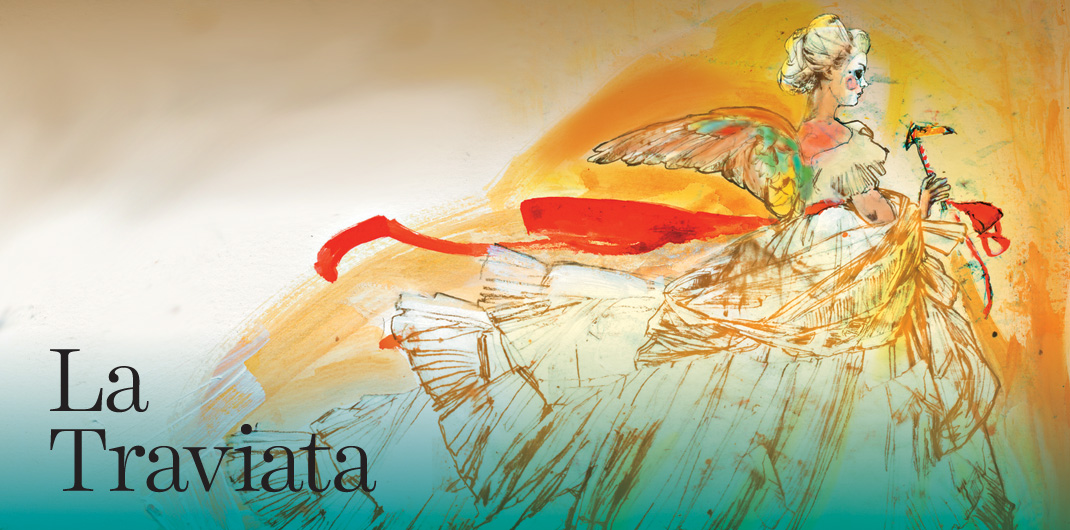
La Traviata

 
 Soon after it's disastrous premiere in 1853, La Traviata became one of the most widely performed operas in the standard repertoire and with Verdi's 200th Birthday this year it is the #1 performed opera in the world for the 2013-2014 season. Beyond the obvious appeal of Verdi's melodies, Alexandre Dumas' story of heartbreak, and the classic tale of redemption, is the integral theme of women's role in society. The Lyric Opera of Chicago had the chance to say something that is both culturally pertinent and dramatically artistic with their latest production of La Traviata running through December 20th. Unfortunately that did not come to fruition as I hoped given the many skips and squeaky wheels that kept the performance from achieving that end.

  La Traviata is the story of a beautiful courtesan named Violetta Valery who, the audience will soon learn, is dying of consumption. She is a kept woman of the wealthy Baron Douphol and enjoys her role as high society party goer which helps draw her attention away from the sad inevitably that she will be confronted with in the near future. Violetta is introduced to a young admirer named Alfredo Germont who has pined for her from afar. He quickly declares his love and is met with frivolous laughter on the part of Violetta. He continues to shower her with affection to which she soon becomes infected by. As dawn approaches he and the other party hoppers leave and Violetta faces off against her own fears of love, life, and death.
  Time passes and we see Violetta in love with Alfredo and with life looking to the future. Love is quickly interrupted by Alfredo's father who pleads with the sickly courtesan to leave his son for the sake of their family honor. She finally gives in to Germont Pere and accepts her plight of the fallen woman unable to attain happiness. Alfredo thinks her unfaithful and seeks revenge at a party Violetta is to attend along with her former lover, Baron Douphol. Alfredo lucky in cards yet unlucky in love, humiliates her and in his embarrassment flees the party. The final act takes us back to Violetta's room where she lays in wait for either Alfredo or death, which ever is to arrive first. Alfredo makes it in time accompanied by his guilt stricken father with barely enough time to refresh their mutual love before she succumbs.


  The part of Violetta Valery was beautifully sung by the radiant Latvian lyric soprano, Marina Rebeka in her Lyric Opera debut. She sang with a great range of dynamics without breaking the melodic line, ever so important to Verdi's music. Ms. Rebeka easily projected in to the large civic opera house and sounded in wonderful voice as she easily danced her way through the vocal acrobatics of the psychologically conflicted recitative and aria,  "Ah, fors'รจ lui - Sempre libera". Her stage movement was fluid and uninhibited during the more vocally challenging parts of the role, yet at times stale and stiff in the more dramatic acting moments act 2.
Ms. Rebeka was still vocally fresh sounding at the beginning of act 3, but did show signs of fatigue near the end, which I can not blame her for given the difficulty of Violetta and the endurance required to sing it.

  Alfredo Germont was sung buy international tenor, Joseph Calleja who was last heard at the Lyric in the role of Rodolfo. There are two things I should admit with respect to my thoughts on Mr. Calleja. I had heard him in La Boheme last season opposite Anna Netrebko and I was not impressed. During that performance he sounded tired which became more evident with each one of his entrances to the point where his vibrato was wide and his tone shallow and brittle. His performance of Alfredo was much better than that of his Rodolfo. My second admission is that I am not an ardent fan of his voice. Many critics describe it as a throwback to the golden era of opera with his tight squillo vibrato and bright tone, but there seems to be an ever present edge that robs it of its depth. Mr. Calleja sounded a bit tight at the beginning of the performance, but slowly warmed up as the night went on. Unfortunately it wasn't until the last act that he sounded his best. To be fair, he sang with sensitivity and dynamic variation and was in good voice from top to bottom, but consistently clipped off the ends of musical phrases which gave the impression that he was anticipating the breath too quickly. His acting was stiff, a theme shared by most all of the players. Mr. Calleja consistently dashed off stage during his exits as if the character had pressing matters in town that required his immediate attention, or taxi carriages were in short supply in Paris during the mid 19th century.

  The part of Alfredo's father, Giorgio Germont, was sung by baritone and Ryan Center alumni, Quinn Kelsey, whose performance I thoroughly enjoyed in last season's Simon Boccanegra. Mr. Kelsey has become an internationally renowned Verdi baritone with his beautifully rounded and dusky tone. Mr. Kelsey's voice is nicely connected with an easy sounding upper register which has no problem projecting in to the house, yet maintains its sweetness. Still, I was disappointed by how Mr. Kelsey chose to sing much of his showcasing moments, such as the famous act 2 aria, "Di Provenza il Mar, il suol", with a Verdian sprech stimme making him sound choppy and disconnected. Although this stylistic choice may give the audience an aural appearance of an older man, it robs the singer of color and depth of sound which, in my humble opinion is needed in a part like Germont. Mr. Kelsey's dramatic interpretation was quite one sided and brutish, as if Alfredo's father was not an educated Parisian, but a disciple of Russian Tsar, Peter the Great. Given the consistency of placid acting evident in the absence of sensitivity towards a humiliated and dying woman, one has to question if this shortcoming is the responsibility of the performers or an absence of proper stage blocking and overall vision.

  The comprimario roles were mostly sung  by Ryan Center young artists with mixed results. Young baritone, Nicholas Pallesen sang the role of Baron Douphol. Mr. Pallesen has a lovely, bright tone that I look forward to hearing more of, although I prefer a darker sounding voice for this role given the fact that the Baron is middle aged. Mezzo soprano, Julie Ann Miller stood out in the role of Violetta's maid, Annina. She sang with a connected line and lovely tone that blended well with that of Marina Rebka.

  Conducting the Lyric orchestra was international Maestro, Massimo Zanetti, considered to be a Verdi specialist. The Lyric Opera Orchestra sounded beautiful as always, but much like the performance of Parsifal that I heard last month, I didn't feel that Maestro Zanetti brought more out of the orchestra than was already there with respect to interpretation. Early on during the act 1 party scene, the orchestra and chorus were unmistakably off from each other which was quite surprising at this level of production. I would have expected something like this from early performances of a long running Broadway production that was still gaining traction, but not from a top tiered opera house ensemble and well respected conductor.

Making her Lyric Opera directing debut in the production was New York based associate artistic director at Theater for a New Audience, Arin Arbus. Her previous directorial experience in opera was with the HGO in their production of The Rape of Lucretia. I thoroughly enjoyed the sets by Riccardo Hernandez and costumes by Cait O'Connor (especially that of the over sized puppets), but was disappointed by the unrealized dramatic potential. As mentioned in the beginning of this review, although La Traviata is timeless, the story of women's plight in the 21st century in the hands of the right director can add an energy and life that so many operatic productions are desperate to acquire. This production missed those opportunities as evident in the party scene of act 2 where Ms. Arbus missed blocking opportunities to convey the strangling effect of being a courtesan had on Violetta and having to withhold her true feelings for Alfredo. Operatic audiences have always been asked to extend quite a bit of leeway with respect to suspension of disbelief, but the unrealistic staging and lack of sensitivity towards the action became ridiculous. Characters squabbled with one another as Violetta lay unconscious or dying which made them appear unsympathetic and cruel, rather than repentant and guilt stricken as Verdi intended.

Even with these obvious blemishes, I enjoyed Lyric Opera's production of La Traviata because of the higher than normal caliber of singing and the obvious star of the show being the birthday boy, Giuseppe Verdi. I did not shed any tears in the moments that I should have, so might I suggest that audience members take advantage of the 2 intermissions and indulge in an extra libation or two before the last act.