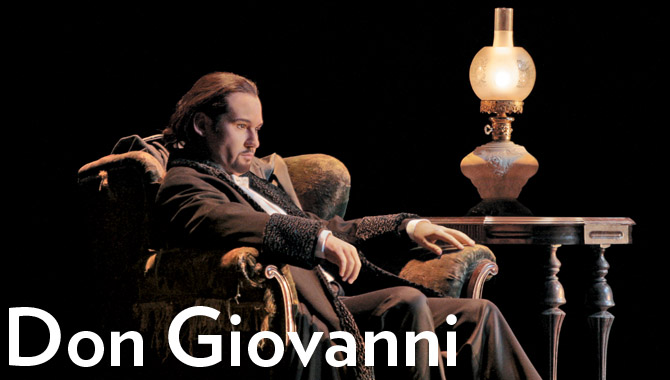
Don Giovanni is the legendary tale of Don Juan, a story told by many with its earliest written form attributed to Tirso de Molina, published in 1630. It has been taken on by some of the pillars of literature such as Moliere and Byron to name a few. Don Giovanni was commissioned for Prague as a result of Mozart's overwhelming popularity and was the second of three operas that the composer teamed up with librettist, Lorenzo Da Ponte. Each one of the three Italian operas focused on the relationships between the classes, the sexes, and society as a whole. On the surface, the story of Don Giovanni appears to be that of a infamous Lothario who finally gets his comeuppance, when in fact, it is much deeper and more complex than that.
The Lyric Opera's opening production of its 60th season attempted to pose these questions, confront those issues, and shake the foundation of this classic work, for better or for worse. Set in 1920's Spain, this modern production was intent on challenging preconceived notions of how Don Giovanni should be staged and ruffle the feathers of anyone who dared effrontery. Challenge accepted.
Polish baritone, Mariusz Kwiecien in one of his signature roles, sang the part of the libidinous Don Giovanni. Mr. Kwiecien has a dark and smoky lyric baritone that had no problem being heard in the cavernous space of the Civic Opera House. He sounded in healthy voice and threw himself in to the role, vocally and dramatically. It would be disingenuous of me to say that I didn't have some concerns about the casting of Mr. Kwiecien. I had only heard him sing on recording, whether it be clips from Youtube or HD telecasts from the MET. When listening to those various recordings, Mr. Kwiecien sounds a bit tenuous when it comes to singing in the passaggio, especially in sustained phrases. Upon hearing him in the role of Don Giovanni Tuesday night, my thoughts on his singing were both that of pleasant surprise and confirmation. He had more than enough stamina for the role and didn't have to oversing, although he had more than enough ability to sing forte and maintain his vocal quality. It was in the more lyric numbers where Mr. Kwiecien's underbelly was shown. In the duet, "La ci darem la mano", his voice was wobbly and lost its rich color. There were times when it sounded as though he may break. The same could be said for his Act 2 aria, "Deh vieni alla finestra". His vibrato was slower than normal and wider in the first section of the aria, which returned to normal near the end when Mr. Kwiecien sang forte with more support.
His acting was in line with the dramatic them set by the director and my only criticism would be his actions in Don Giovanni's final scene. In this production, the Don is shot in the right shoulder, yet he continues to use it unimpaired to eat, drink, and even climb an obstacle course, if you will. I thought this a bit ridiculous to say the least, but one could argue that Mr. Kwiecien had no choice given the stage direction.
As I have stated in previous blogs on Lyric Opera productions, if the title of the opera was based on the best singing, then it would most definitely be called Donna Anna. Latvian soprano, Marina Rebeka, heard last season as Violetta in Verdi's La Traviata, was once again the vocal star. Not only did she sing with a beautiful line, control, dynamics, and dramatic sensitivity, as she did in the Traviata production, but she had more of the dramatic color needed for the role of Donna Anna without sounding artificial. Her singing was fluid and agile, evident in the opening trio, "Non sperar, se non m'uccidi, Ch'io ti lasci fuggir mai!" and subsequent duet between Donna Anna and Don Ottavio, "Ah, vendicar, se il puoi, giura quel sangue ognor!". Ms. Rebeka could go from singing a beautiful listless piano, then turn on a dime to deliver a pain stricken forte with the appropriate color which was all the acting that Donna Anna requires. Much like Mr. Kwiecien, Ms. Rebeka didn't show any major signs of fatigue in her final aria, "Non mi dir", in which she sounded fluid and agile.
Upon finding my seat for the production, I decided not to read through program. I knew that Mr. Kwiecien, Ms. Rebeka, to name a few, were singing in the production, but given the fact that I admittedly had some preconceived notions, just sat back and did not remind myself of the other big names. I had totally forgotten that Ana Maria Martinez was singing the role of Donna Elvira and it wasn't until intermission that I saw her name in the program. This reminded me of how beautiful her voice was, as I didn't recognize her upon her entrance given the fact that she was dressed as a saucy red-haired Amelia Earhart. Ms. Martinez sang in Othello and Rusalka last season, both parts portraying earnest women in love, a stark contrast to Donna Elvira, a scorned woman with no where to turn. Even though Ms. Martinez has wonderful voice and sings beautifully, she did have obvious trouble with the fioritura in the Act 1 quartet, "Non ti fidar, o misera" and similar fast moving passages. What I took umbrage with in regard to the performance of Ms. Martinez was her histrionic reactions and indulgent movements when interpreting strong emotion. At one point, I half-expected Donna Elvira and Don Giovanni to begin wrestling at the side of the stage during the aforementioned quartet. The character of Donna Elvira is emotionally brittle and forlorn, but not in a state of constant tremors.
The part of Don Giovanni's conflicted assistant, Leporello, was sung by American bass-baritone, Kyle Ketelsen. Mr. Ketelsen sang the role of Don Basilio in last year's production of The Barber of Seville at the Lyric Opera, in which I thought him miscast, not because of his singing or performance, but rather the fact that his voice is more baritone than bass and as such did not carry the heft for the role. His voice and demeanor is perfectly suited for that of Leporello. He not only stood out vocally among the male cast members, but in acting as well. He was relaxed and confident in his characterization and like Ms. Rebeka, used his voice to impart the interpretation rather than his limbs. Mr. Ketelsen didn't let the demanding stage direction to get in the way of his singing which put me at ease after hearing Leporello's opening aria, "Notte e giorno faticar", sung rather than barked.
The part of Don Ottavio, Donna Anna's fiance, was sung by Italian tenor, Antonio Poli. I had heard Mr. Poli last season in the Lyric's production of Othello in the role of Cassio. In the blog review for that production I had noted that Mr. Poli sang beautifully and was glad to see that he may call Chicago a second performance home given his connection to Maestro Riccardo Muti. I was disappointed by his singing in the role of Don Ottavio. Last season his voice sounded fresh and bright with what seemed to be an easy production. On Tuesday night Mr. Poli's voice sounded tired and tight. His vibrato was wide and the upper part of his range was a bit strident and pushed. I hope that this was only an off night and he bounces back to the fresh sounding lyric tenor that he is.
Canadian soprano and Ryan Center alumna, Andriana Chuchman made her role debut as Zerlina. Ms. Chuchman has a bright lyrical sound that typifies the naïve and inexperienced Zerlina. She consistently sang with a line which brought out the bright color of her voice. At times her singing could be a bit disconnected, but she was required to be rolling around and moving quite a bit in this production.
Zerlina's fiancé, Masetto was sung by American bass-baritone, Michael Sumuel. I really enjoyed Mr. Sumuel's singing and paranoid performance. He has a rich sound with a tight vibrato that carried through the hall in a beautiful line. Mr. Sumuel brought out the emotion and fury of Masetto without coming off his voice. His bass-baritone sounds more lyrical at this point in his career which may very well darken as time goes on.
The role of Il Commendatore was sung by well known Italian bass, Andrea Silvestrelli. At his best, Mr. Silvestrelli has a cavernous voice that sounds as if it could carry on for ever and reach the depths of a bottomless pit, but he didn't seem to be at his best. His vibrato was a bit wide at times and overall his voice sounds gravelly. It can still carry all the way to the back of the hall even when competing with a full orchestra playing forte, but the consistent beauty no longer seems to be there.
Sir Andrew Davis conducted the orchestra which sounded top notch as usual. I was happy not to complain about the orchestra covering up the singers which seemed to be a recurring theme last season, but most all of the voices were big enough to carry over the smaller sized orchestra of late 18th century opera compared to that of the later 19th century. I thoroughly enjoyed the opening overture which the orchestra played in a crisp and clean manner. Sir Andrew Davis took the final scene with Don Giovanni a bit fast for my taste, but I didn't complain under the circumstances of this production.
The set design by Walt Spangler set in 1920's Spain was simple, yet classically elegant with depth and character. The stucco and marble architecture provided a wonderful background for the colors of each scene that pervaded the story. The clean design helped to support the rich and at times beautifully decadent costumes designed by Ana Kuzmanic. They ranged from period 1920's signature clothing, to classic formal wear, down to traditional Spanish dresses with untraditional design which made those characters stand out in a crowd.
Multiple award winner and Artistic Director of Chicago's Goodman Theater, Robert Falls is at the helm of stage direction for Don Giovanni. In the director notes of the program, Mr. Falls explains the reasoning behind setting Don Giovanni in 1920's Spain.
"...I wanted to introduce a 20th century sensibility and psychology to the piece...I should emphasize that the result is not a documentary about the 1920's, but rather a highly theatricalized world that uses the 1920's as a point of reference."
Mr. Falls also explains in those opera notes that when taking on a production of Don Giovanni, a director has to try and answer dozens of questions posed by the open-ended and mysterious work, which I wholeheartedly agree with. Suffice it to say, there are layers upon layers of themes and questions that are ultimately posed to the audience to ponder, especially in light of Giovanni's descent in to hell. One of the constant struggles for the Opera world is to keep timeless works, such as Don Giovanni, fresh and relevant. A popular attempt at that by Opera companies and Directors alike have been updating the setting to modern time periods. I applaud Mr. Falls' strong artistic vision which does, in my humble opinion, steer off the beaten track of the classic productions of Don Giovanni, with regard to inner compass of Don Giovanni himself.
Mr. Falls makes the Don out to be a perpetually drunk, drug sniffing, sex addicted, sociopathic, misogynistic, serial-rapist, control freak who may very well be willing to crash a plane he's flying if given the chance to bang a passenger. This angle, however courageous and unwavering, did not work for me, not because I am unwilling to break out of the mold of the classic setting of this work (or any other opera for that matter), but I felt Mr. Falls betrayed the underlying message and/or question of the piece by focusing on the spectacle of his vision. As Mr. Falls relates in one of the Lyric Opera's interviews that can be located on its You Tube channel, Don Giovanni is not a "nice guy". Mr Falls goes on to explain in that interview that Don Giovanni can be viewed as an "anti-hero" who you root for even though he does evil things at times. I agree with that explanation, but I would say that that was not achieved in this production of Don Giovanni. At no time was I rooting for the main character, nor did I believe that the women of this work, save for Donna Elvira, would either get involved with him or have any desire to stay given the fact that he was constantly abusing and demeaning most all of the women according to Mr. Falls' artistic direction. His consistent manhandling and mocking of his conquests not only made the character flat and one-sided, but also made the female characters, big and small, out to be willing punching bags for him.
After a while the Don's behavior became monotonous and mean. The "highly theatricalized" direction that Mr. Falls took was disjointed and resembled a collage of pictures cut from various magazines and glued together unwilling to hide the seams. I got the impression that Mr. Falls' vision of Don Giovanni was based on Tony Montana from the movie Scarface transported back to the roaring 20's alongside obviously modern movie references such as an interpolated orgy scene taken from Stanley Kubrick's, Eyes Wide Shut, complete with masks and ménage-a-trois. The sensationalistic behavior, whether it be snorting cocaine off women's breast, street side oral sex, or a half-naked woman chained to the wall with visible bruises received at the hands of the Don, are just a few of the examples of how this production's focus was on shock and spectacle rather than story and singing.
The saving grace of this production, which was most definitely a close one, is the singing and musical drama of Mozart and Da Ponte. For the inexperienced opera goer or novice, I would say to go if given the chance, but for the opera enthusiast, I think this is a prime example of how Opera is being dumbed down to a visual medium rather than the aural amazement that it can be. From the orchestral reference to the aria, "Non piu andrai" being piped through speakers made to sound like a radio to the Commendatore's voice being artificially amplified for spooky effect, these small steps are unfortunately breaking away the cornerstone of what Opera is in order to attract younger audiences unaware of this dismantling.
