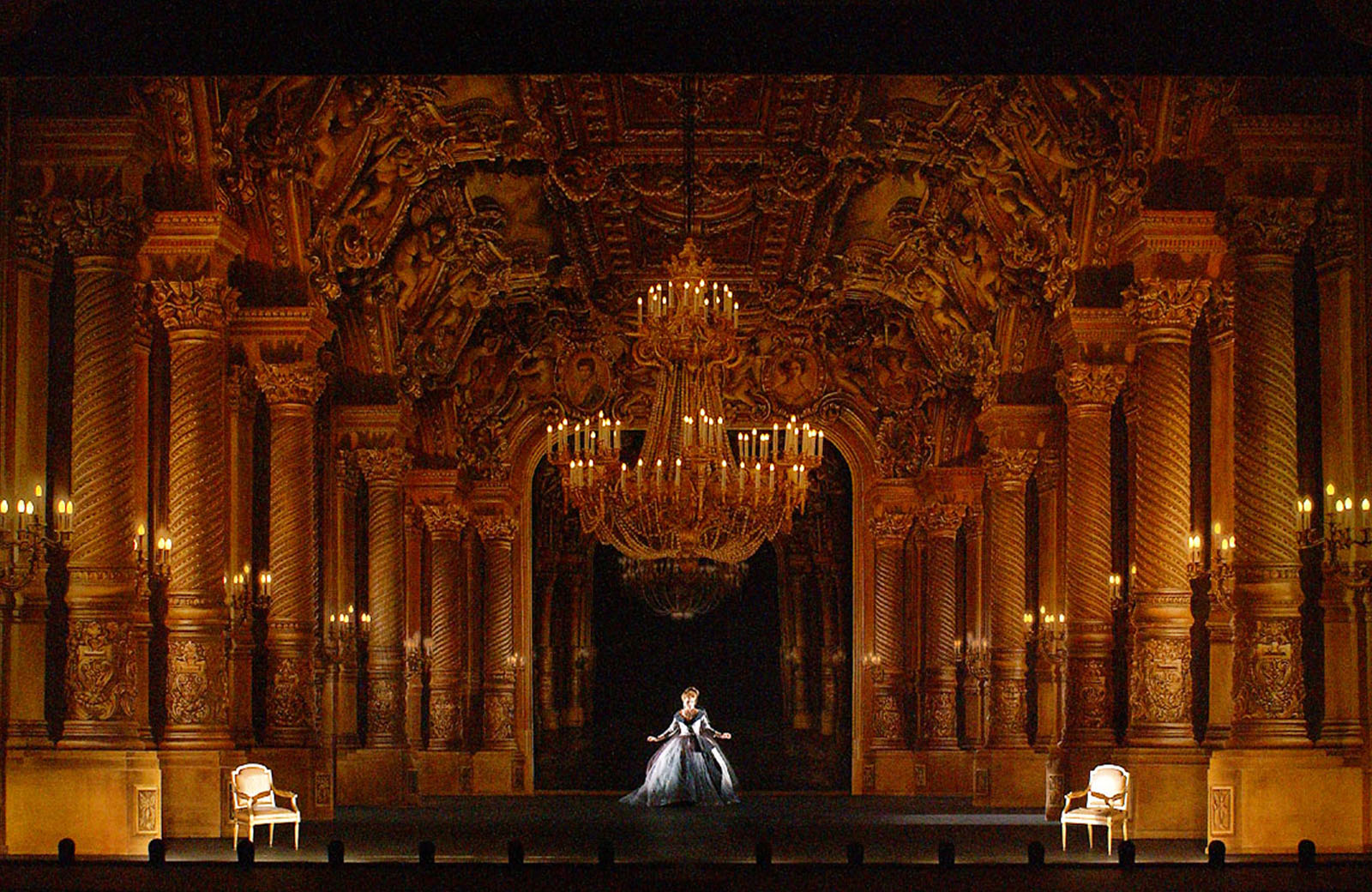
Capriccio, an operatic discussion on opera in an opera, delves in to the never ending debate of what is most important. Words or music. This chamber opera by Richard Strauss, premiered in 1942, was originally set in a mid 18th century French salon made legend by the likes of Mme Geoffrin. It has been updated in this production to a large drawing room of Countess Madeleine and her brother in the mid 1920's. The Countess is entertaining a small group of people which includes two hopeful suitors for her hand in marriage, Flamand a composer and Olivier a poet. The love triangle serves as a metaphor over the battle of importance in opera, highlighted by references to Gluck and his operas which serve as a springboard. Gluck was constantly striving to find an artistic balance between music and words. The composer wrote in a preface to the published form of the opera Alceste,
"When I undertook to write the music for Alceste, I resolved to divest it entirely of all those abuses....which have so long disfigured Italian Opera....I have striven to restrict music to its true office of serving poetry by means of expression, and by following the situations of the story, without interrupting the action or stifling it with useless superfluity of comments."
This is the heart of the tongue in cheek debate of Strauss' characters with the underlying dramatic question of which suitor the Countess will choose.
The part of Countess Madeleine was sung by world-renowned soprano, Renée Fleming, a role like so many that is identified with her. I was fortunate enough to have heard Ms. Fleming sing the role of the Countess in Mozart's, Le Nozze di Figaro in the late 90's at the Lyric Opera and was blown away, not only by the volume and beauty of her voice, but perhaps more so by the control. That control was seldom heard in the same way during this performance of Capriccio. It gives me no pleasure whatsoever to say that I believe Ms. Fleming is at the ending point of her long and illustrious career. This performance was the third time that I have been able to hear Ms. Fleming in a live setting. As I mentioned, the first being in the late 90's and the second, this past March again at the Lyric Opera in a special recital alongside the great German tenor, Jonas Kaufmann. Ms. Fleming still sounded wonderful at that recital, but I could tell that time had taken its toll on her voice, as it does with everyone at some point. From the start, her singing in Capriccio seemed to be slightly uneasy. Given the time of year I thought that weather and possible illness could be a reason for this, but as the night went on it was clear that Miss Fleming's singing was more of a permanent adjustment rather than one related to a temporary setback. Her voice was consistently wobbly and lacking warmth when sitting in the passaggio and Ms. Fleming sang with much more straight tone and scoop than she has in the past. She seemed timid about sustaining notes in the higher part of her range and would quickly portamento down to the next note in the line when possible, although the true beauty and artistry of her voice came through in many places in the final scene in which the Countess contemplates her choice between words and music. Ms. Fleming sang with line in a shimmering piano easily moving throughout her range without having to maneuver the large intervals with straight-tone. It should come as no surprise that she looked beautiful as ever despite having a teal green dress with muffs that looked like it was more for the Dowager of Downton Abbey, rather than Renée Fleming.
American tenor, William Burden sang the role of Flamand the composer, one of the two suitors vying for the Countess' hand in marriage. Mr. Burden has a sweet bright tone that sounded easily produced and well-connected. There were many times throughout the opera when it was difficult to hear Mr. Burden or make out his diction, which I don't necessarily fault him or any of the other artists for given talkative nature of the opera and the fact that the Civic Opera House is in my opinion, too big a venue for this piece. Mr. Burden's acting was confident and subtle. He was believable as the character he portrayed and one of the better tenors that the Lyric has engaged in recent years.
The other half of this dueling duo, Olivier the poet, was sung by Norwegian baritone, Audun Iversen. Mr. Iversen has a deeply rich tone that has dramatic qualities with a rolling vibrato that maintains the lyrical aspects of his voice. Mr. Iversen's voice sounded easily produced, much like Mr. Burden's, and succeeded in giving the listener the impression of dialogue in the word heavy exchanges. Unlike his tenor counterpart, Mr. Iversen's acting was not the highlight of his evening. His ever frantic and redundant gestures meant to portray Olivier as an uptight worry wart only distracted from the quick change of sung dialogue. I think it would've been prudent for Mr. Iversen to employ the "less is more" school of acting, especially given the 4 screens that the Lyric Opera had up in order to give the audience a cinematic perspective via closely framed shots.
The role of La Roche the theater director, was sung by British bass, Peter Rose. Mr. Rose, like Ms. Fleming, is known for his interpretations of Strauss characters, especially this one. Mr. Rose had been sick earlier in the run which did have a slight lingering effect on his performance, but one could tell that even at less than 100%, he was at home in this role both vocally and dramatically. Mr. Rose, a bass, has a more lyrical quality to his voice than what one would expect. He seems to be a true example of a
basso-cantante. Mr. Rose combined nuance and dynamic variation in both his singing and acting without overdoing either. He did have some difficulty with the top of his voice during La Roche's long aria, but once again, I can only assume without having heard him before that this was due to the residual effects of his throat infection.
The role of Clarion the actress was sung by internationally renowned mezzo-soprano, Anne Sofie Von Otter. I read in the Lyric program notes that Ms. Von Otter had not sung at the Lyric since the 1989-90 season and after hearing this performance, I think it should have stayed that way. Ms. Von Otter did not sound to be in good voice. I can't say for certain that this is a result of years spent singing in various styles which may have had a detrimental effect on her operatic technique, but her voice was consistently disconnected and at times warbly. I enjoyed her easy acting and the few moments in which she recited a monologue in spoken voice. I wonder if the Lyric Opera couldn't have found a singer with a stronger technique who could have given more to this role which seems to be a recurring question each time I visit the Civic Opera House.
The role of the Count was sung by Danish baritone and Chicago favorite, Bo Skovhus. Despite my criticisms of aspects of his performances, including this one, I happily admit that he makes me smile as a result giving the impression that he whole-heartedly enjoys being on stage. His acting was over the top and contrived much like my criticism of his performance in last season's Die Fledermaus, but still it was hard to stay angry because of the positive energy he exudes. Mr. Skovus' voice hasn't changed as far as color and tone go, but it's not as vibrant as it once was and he tends to sound a bit nasal when in the upper part of his range. To be fair, perhaps this part doesn't really give Mr. Skovus a chance to show what his voice is able to do at this point in his career.
The comprimario parts of the Italian singers were performed by soprano, Emily Birsan and tenor, Juan Jose De Leon. The couple's voices blended well together and they were a nice injection of humor when needed. The men from "downstairs", consisting of current and past members of the Ryan Center young artist program, helped to add comedy and an additional perspective to the opera in an opera concept. A highlight being the brief exchange between the American tenor, Keith Jameson as Monsieur Taupe and American bass-baritone, David Govertsen in the role of Majordomo.
Strauss rightfully included a moment for a pair of ballet dancers to be introduced and perform at the small gathering which was apropos for the time period of the mid 18th century in which the composer had originally set the piece in. Not only was the respite of dance enjoyable, but it added to the already complex debate on music, art, and poetry. The parts were split between the pair of Jennifer Goodman and Randy Herrera and Jeffrey B. Hover Jr. and Abigail Simon.
The orchestra was once again led by international conductor, Sir Andrew Davis. Although the orchestra sounded as professional and top notch as they normally do, I was quite disappointed by the lack of dynamic variety and color which, in my opinion, is the direct responsibility of the conductor, especially one that is closely associated with the piece almost as much as Renée Fleming. This opera is already a challenge to singers given the talkative nature of the long recitative sections in addition to being performed in a large hall like the Civic House, so it was with great disappointment, but hardly surprising that Sir Davis did not restrain the volume of the orchestra as to not cover the singers. One would have thought that Sir Andrew Davis would've taken the clue given by the character, La Roche when he sings,
"The fundamental defect in every opera is the deafening noise of the orchestra. Its roaring and raging swallows the voices. The singers are simply forced into yelling."
Alas, he did not.
Peter McClintock was the director for this revival, originally by John Cox which has been produced in opera houses the world over. The time period, originally set in mid 18th century French salon, was updated to an early 20th century drawing room. The set, by designer Mauro Pagano was quite beautiful and warm which was wonderfully supported by the interior décor and costumes by Robert Perdziola.
Capriccio is a wonderful concept of a piece that for me personally was an hour too long, which is not all that different from the complaints made about opera by the average novice audience member. This opera is would be best produced in a much smaller theater so that the audience can take in the nuances which the composer dictated. When an opera house like the Lyric has to have four screens in simulcast of the production being performed on stage, which was quite a distraction, that may be a sign that the venue is too big for a character piece like this one.

