Showing posts with label Opera review. Show all posts

Tuesday, November 4, 2014

Capriccio


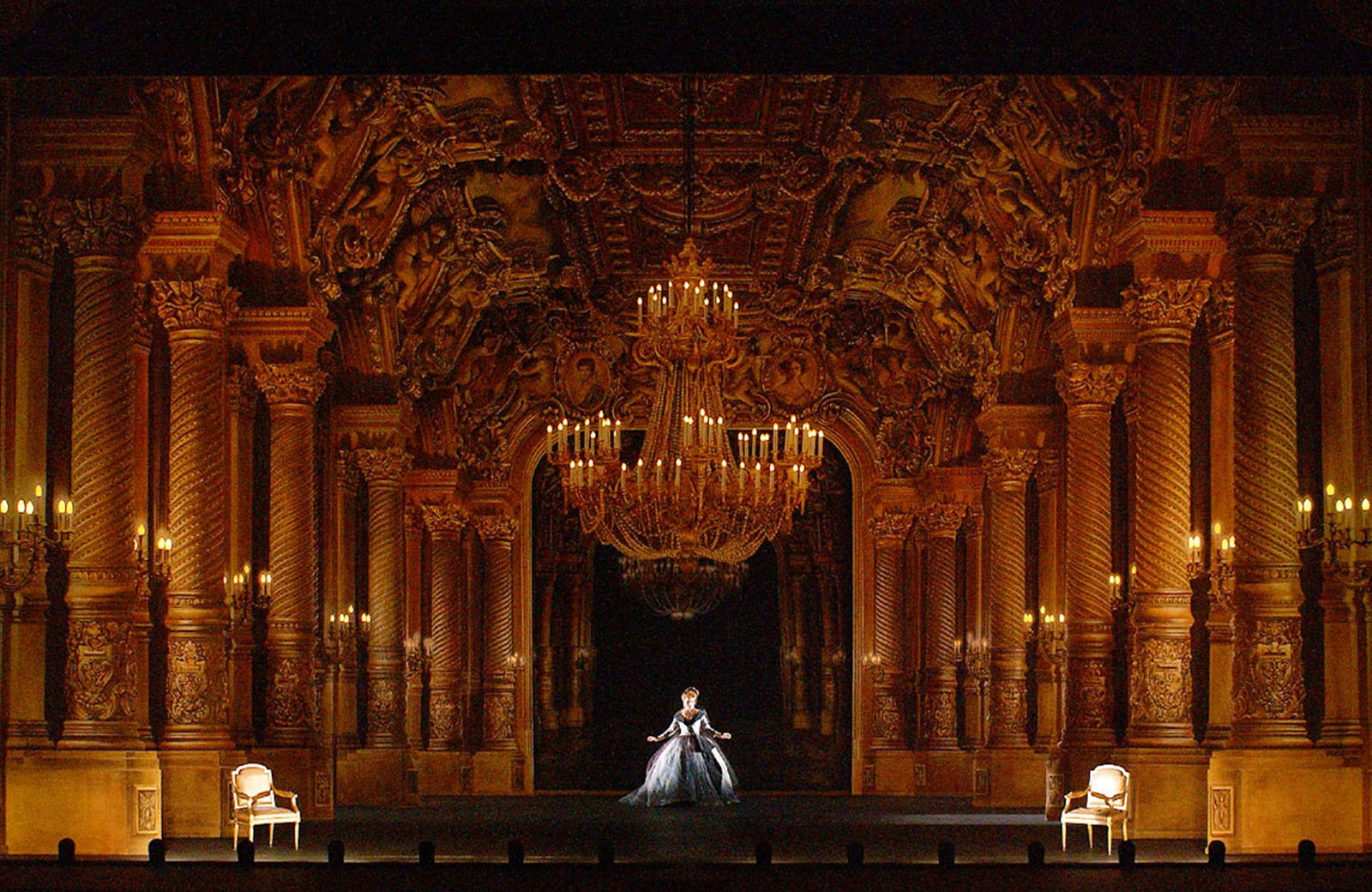
  Capriccio, an operatic discussion on opera in an opera, delves in to the never ending debate of what is most important. Words or music. This chamber opera by Richard Strauss, premiered in 1942, was originally set in a mid 18th century French salon made legend by the likes of Mme Geoffrin. It has been updated in this production to a large drawing room of Countess Madeleine and her brother in the mid 1920's. The Countess is entertaining a small group of people which includes two hopeful suitors for her hand in marriage, Flamand a composer and Olivier a poet. The love triangle serves as a metaphor over the battle of importance in opera, highlighted by references to Gluck and his operas which serve as a springboard. Gluck was constantly striving to find an artistic balance between music and words. The composer wrote in a preface to the published form of the opera Alceste,

  "When I undertook to write the music for Alceste, I resolved to divest it entirely of all those abuses....which have so long disfigured Italian Opera....I have striven to restrict music to its true office of serving poetry by means of expression, and by following the situations of the story, without interrupting the action or stifling it with useless superfluity of comments."

  This is the heart of the tongue in cheek debate of Strauss' characters with the underlying dramatic question of which suitor the Countess will choose.

  The part of Countess Madeleine was sung by world-renowned soprano, Renée Fleming, a role like so many that is identified with her. I was fortunate enough to have heard Ms. Fleming sing the role of the Countess in Mozart's, Le Nozze di Figaro in the late 90's at the Lyric Opera and was blown away, not only by the volume and beauty of her voice, but perhaps more so by the control. That control was seldom heard in the same way during this performance of Capriccio.  It gives me no pleasure whatsoever to say that I believe Ms. Fleming is at the ending point of her long and illustrious career. This performance was the third time that I have been able to hear Ms. Fleming in a live setting. As I mentioned, the first being in the late 90's and the second, this past March again at the Lyric Opera in a special recital alongside the great German tenor, Jonas Kaufmann. Ms. Fleming still sounded wonderful at that recital, but I could tell that time had taken its toll on her voice, as it does with everyone at some point. From the start, her singing in Capriccio seemed to be slightly uneasy. Given the time of year I thought that weather and possible illness could be a reason for this, but as the night went on it was clear that Miss Fleming's singing was more of a permanent adjustment rather than one related to a temporary setback. Her voice was consistently wobbly and lacking warmth when sitting in the passaggio and Ms. Fleming sang with much more straight tone and scoop than she has in the past. She seemed timid about sustaining notes in the higher part of her range and would quickly portamento down to the next note in the line when possible, although the true beauty and artistry of her voice came through in many places in the final scene in which the Countess contemplates her choice between words and music. Ms. Fleming sang with line in a shimmering piano easily moving throughout her range without having to maneuver the large intervals with straight-tone. It should come as no surprise that she looked beautiful as ever despite having a teal green dress with muffs that looked like it was more for the Dowager of Downton Abbey, rather than Renée Fleming.

  American tenor, William Burden sang the role of Flamand the composer, one of the two suitors vying for the Countess' hand in marriage. Mr. Burden has a sweet bright tone that sounded easily produced and well-connected. There were many times throughout the opera when it was difficult to hear Mr. Burden or make out his diction, which I don't necessarily fault him or any of the other artists for given talkative nature of the opera and the fact that the Civic Opera House is in my opinion, too big a venue for this piece. Mr. Burden's acting was confident and subtle. He was believable as the character he portrayed and one of the better tenors that the Lyric has engaged in recent years.

  The other half of this dueling duo, Olivier the poet, was sung by Norwegian baritone, Audun Iversen. Mr. Iversen has a deeply rich tone that has dramatic qualities with a rolling vibrato that maintains the lyrical aspects of his voice. Mr. Iversen's voice sounded easily produced, much like Mr. Burden's, and succeeded in giving the listener the impression of dialogue in the word heavy exchanges. Unlike his tenor counterpart, Mr. Iversen's acting was not the highlight of his evening. His ever frantic and redundant gestures meant to portray Olivier as an uptight worry wart only distracted from the quick change of sung dialogue. I think it would've been prudent for Mr. Iversen to employ the "less is more" school of acting, especially given the 4 screens that the Lyric Opera had up in order to give the audience a cinematic perspective via closely framed shots.

  The role of La Roche the theater director, was sung by British bass, Peter Rose. Mr. Rose, like Ms. Fleming, is known for his interpretations of Strauss characters, especially this one. Mr. Rose had been sick earlier in the run which did have a slight lingering effect on his performance, but one could tell that even at less than 100%, he was at home in this role both vocally and dramatically. Mr. Rose, a bass, has a more lyrical quality to his voice than what one would expect. He seems to be a true example of a
basso-cantante. Mr. Rose combined nuance and dynamic variation in both his singing and acting without overdoing either. He did have some difficulty with the top of his voice during La Roche's long aria, but once again, I can only assume without having heard him before that this was due to the residual effects of his throat infection.

  The role of Clarion the actress was sung by internationally renowned mezzo-soprano, Anne Sofie Von Otter. I read in the Lyric program notes that Ms. Von Otter had not sung at the Lyric since the 1989-90 season and after hearing this performance, I think it should have stayed that way. Ms. Von Otter did not sound to be in good voice. I can't say for certain that this is a result of years spent singing in various styles which may have had a detrimental effect on her operatic technique, but her voice was consistently disconnected and at times warbly. I enjoyed her easy acting and the few moments in which she recited a monologue in spoken voice. I wonder if the Lyric Opera couldn't have found a singer with a stronger technique who could have given more to this role which seems to be a recurring question each time I visit the Civic Opera House.

  The role of the Count was sung by Danish baritone and Chicago favorite, Bo Skovhus. Despite my criticisms of aspects of his performances, including this one, I happily admit that he makes me smile as a result giving the impression that he whole-heartedly enjoys being on stage. His acting was over the top and contrived much like my criticism of his performance in last season's Die Fledermaus, but still it was hard to stay angry because of the positive energy he exudes. Mr. Skovus' voice hasn't changed as far as color and tone go, but it's not as vibrant as it once was and he tends to sound a bit nasal when in the upper part of his range. To be fair, perhaps this part doesn't really give Mr. Skovus a chance to show what his voice is able to do at this point in his career.

  The comprimario parts of the Italian singers were performed by soprano, Emily Birsan and tenor, Juan Jose De Leon. The couple's voices blended well together and they were a nice injection of humor when needed. The men from "downstairs", consisting of current and past members of the Ryan Center young artist program, helped to add comedy and an additional perspective to the opera in an opera concept. A highlight being the brief exchange between the American tenor, Keith Jameson as Monsieur Taupe and American bass-baritone, David Govertsen in the role of Majordomo.

  Strauss rightfully included a moment for a pair of ballet dancers to be introduced and perform at the small gathering which was apropos for the time period of the mid 18th century in which the composer had originally set the piece in. Not only was the respite of dance enjoyable, but it added to the already complex debate on music, art, and poetry. The parts were split between the pair of Jennifer Goodman and Randy Herrera and Jeffrey B. Hover Jr. and Abigail Simon.

  The orchestra was once again led by international conductor, Sir Andrew Davis. Although the orchestra sounded as professional and top notch as they normally do, I was quite disappointed by the lack of dynamic variety and color which, in my opinion, is the direct responsibility of the conductor, especially one that is closely associated with the piece almost as much as Renée Fleming. This opera is already a challenge to singers given the talkative nature of the long recitative sections in addition to being performed in a large hall like the Civic House, so it was with great disappointment, but hardly surprising that Sir Davis did not restrain the volume of the orchestra as to not cover the singers. One would have thought that Sir Andrew Davis would've taken the clue given by the character, La Roche when he sings,

"The fundamental defect in every opera is the deafening noise of the orchestra.  Its roaring and raging swallows the voices. The singers are simply forced into yelling."

  Alas, he did not.

  Peter McClintock was the director for this revival, originally by John Cox which has been produced in opera houses the world over. The time period, originally set in mid 18th century French salon, was updated to an early 20th century drawing room. The set, by designer Mauro Pagano was quite beautiful and warm which was wonderfully supported by the interior décor and costumes by Robert Perdziola.

  Capriccio is a wonderful concept of a piece that for me personally was an hour too long, which is not all that different from the complaints made about opera by the average novice audience member. This opera is would be best produced in a much smaller theater so that the audience can take in the nuances which the composer dictated. When an opera house like the Lyric has to have four screens in simulcast of the production being performed on stage, which was quite a distraction, that may be a sign that the venue is too big for a character piece like this one.

Thursday, February 20, 2014

The Barber of Seville


    As is the case with so many dramas, the histrionic storyline on stage can sometimes be overshadowed by the melodramatic happenings outside. So is was with Rossini's, "The Barber of Seville". As noted in the Lyric Opera program notes, Rossini faced an angry set of sycophants at the premiere. The Italian claque were in attendance to not only show their unpleasant reaction to Rossini's opera, but to voice their support for the composer, Giovanni Paisiello who had originally set Beaumarchais' story to music. The first "Barber of Seville" had its premier in 1782 and was considered a mainstay on the operatic stage up to that time. After the disastrous 1816 premiere, like most comic operas, Rossini won out in the end and his version of "The Barber of Seville" is the true main stay nearly 200 years later. This opera holds special memories for me, most of all being that this was the first production that I heard at the Lyric Opera of Chicago back in 1994, with Rockwell Blake as Count Almaviva.
 
  The title may be The Barber of Seville, but judging by the individual performances of this production, I would have to change that to "Rosina's Revenge". American Mezzo-Soprano, Isabel Leonard made her Lyric Opera debut with a vocal splash as the servile, yet spirited Rosina. Her dark round tone was sung in a beautifully connected line that bloomed, like her characterization, as her voice eased through every part of its range. Ms. Leonard used her impeccable technique to bring out the subtle nuances of Rosina's personality in the aria, "Una voce poca fa", which conveys the true character beneath her outward obedience and charm. Ms. Leonard's voice has a dark polish in the lower range which is a wonderful contrast to the light airy colors that she can employ throughout the middle and upper parts of her voice with ease in Rossini's florid sections. That is not to say that those areas of her voice are light or small. Ms. Leonard had no problem being heard, as evident in the Act II finale when Ms. Leonard is one of two female singers onstage next to 5 male soloists and all male chorus. Both female parts had no trouble carrying past the overwhelming sound of orchestra and men. In addition to the beautiful singing and interpretation, Ms. Leonard's acting was one of the few highlights in an otherwise frenetic staging. The only flaw was near the end of the opera when her vibrato sounded a bit wide, which was understandable given how much singing is required for the role of Rosina.
 
  The part of Count Almaviva was sung by the young American Tenor, Alek Shrader, who was prominently featured in the operatic documentary, The Audition. Mr. Shrader has quickly made a name for himself as a Rossini/Mozart specialist on the international circuit. He has a sweet and agile voice that has little to no problem executing the long passages of fioritura in every area of his vocal range. That's not to say that his singing was perfect with regard to stylistic choices. Mr. Shrader crooned throughout his first aria, "Ecco ridente..." and employed straight tone, especially when moving in to his higher register. This stripped some of the color from the voice and broke up the Bel Canto line, but because of the innate beauty in his tone, most audiences will accept this method without question. Another bit of collateral damage was Mr. Shrader's projection. His voice was difficult to hear at times even when the orchestral dynamics were piano. Mr. Shrader's singing, however naturally beautiful, was inconsistent and veering dangerously close to a pop-like sound. When Mr. Shrader sang with support and core, his voice projected more easily and suddenly had more depth. With regard to his stage presence, he was quite confident in the characterization of Almaviva, but moved too much around the stage. Even when he just stood and sang, there were too many hand gestures and I'm quite sure that he did an Elvis pose at one point.  
 
  Figaro himself was sung by well known American Baritone, Nathan Gunn who is experienced not only in opera, but classic American Musical theater as well. Mr. Gunn has a warm and well rounded tone that is hard not to like, which is basically what I was thinking whenever he sang.
"I want to like him."
It was apparent from his opening cavatina, the ever popular "Largo al Factotum", that the role of Figaro was not necessarily going to be a walk in the park for him. Although Mr. Gunn's voice was a bit bigger than Mr. Shrader's, he had difficulty maintaining his quality of tone throughout the high tessitura of Figaro's opening aria. Mr. Gunn's vibrato was consistently wobbly and uneven throughout the entire opera. It was difficult to pick out his voice in larger ensemble numbers, especially against an orchestral forte. Despite his round and velvety tone, I wonder if Mr. Gunn hasn't inadvertently neglected his operatic technique in pursuit of theatrical interpretations.
 
  In our new title, "Rosina's Revenge", the later would be in reference to the "other" star of this production, word renowned Italian Baritone, Alessandro Corbelli who sang the part of the scheming Dr. Bartolo. I would say that he was the only one of the men to consistently sing with a line. He didn't bark his way through the role, as we have come to expect with it being a slapstick comedy part. I also have to say that it was such a breath of fresh air to hear Signor Corbelli use glottal fry to in order to keep his voice grounded through the fast moving parts that sat in a higher place of his range. This is fast becoming a dying art, which from a technical perspective is a necessity for one who wishes to have a long lasting career in opera. Just ask Mr. Corbelli, who has been singing since the early 70's. In addition to his fine singing, Mr. Corbelli nailed the uptight, highly strung, and effusive nature that is Bartolo.
 
  American Bass-Baritone, Kyle Ketelsen sang the role of Don Basilio. Without any intention of disparaging Mr. Ketelsen's performance, I felt that he was totally miscast in this role. He has a rich dark tone that carried throughout the hall, but it is not the color that is needed for the role. His timbre was far too similar to that of Mr. Corbelli rather than that of a true bass which brings out the texture that Rossini's score calls for. There were times that I felt that Mr. Ketelsen was trying to artificially darken his voice during Basilio's grand aria, "La Calumnia". The casting of a Bass-baritone rather than a Bass was not to my liking which is once again, nothing to do with Mr. Ketelsen.
 
The comprimario roles were filled out with three singers from the Lyric's Ryan Center young artist program. American Baritone, Will Liverman sang the beginning role of Fiorello, which he sang with rich tone and a connected line. Baritone, John Irvin sang well as the Sergeant, but the surprising stand out of the three, in my opinion, was Soprano, Tracy Cantin in the role of Berta. She has a big bright sound that easily carried along side Ms. Leonard in the male heavy Act II finale. The only criticism I had of Ms. Cantin's singing was that during her aria, it sounded as if she was trying to brighten the tone which took away some of the beautiful depth of sound that he voice is capable of.
 
  Leading the orchestra was Italian conductor, Michele Mariotti, making his Lyric Opera debut. Maestro Mariotti did a wonderful job of adhering to the range of dynamics of the score, although I felt that he took many of the tempi too fast, especially those of the consonant heavy "patter" numbers. There were a few moments that I thought Mr. Corbelli was going to pass out due to lack of oxygen. If the tempi had been a tad slower, the singers would not only have a chance for a full breath, but we could hear the pitches more clearly rather than escaping air of endless consonants.
 
  Making his Lyric Opera directorial debut is Rob Ashford, who recently directed "The Sound of Music" which appeared live on TV. Ashford's stage directions seemed overdone with bits of minutia that either missed or caused distraction both visually and aurally. At the start of the opera, the village orchestra players shuffle around the stage which took away from the music. Ashford had Count Almaviva moving around in apparent romantic sturm und drang as he sang his opening aria, at some points with his back to the audience and downstage, which made it challenging for the audience to hear the music clearly. As I stated before, Alek Shrader who sang the role of Almaviva was in constant motion even when standing still. I think this emphasis on the visual in an aural medium is no aberration, but a disconcerting philosophy that stage directors are allowed to pursue with little restraint or balance. I felt that the overall stage direction was a distraction from what I came to hear.
 
 
Both the orchestra and chorus (overwhelmingly male) sounded wonderful with a special nod to the string players who executed the tempi and ever changing dynamic levels with precision.  
 
 
  The set design was by Scott Pask, also making his Lyric Opera debut. I thought it was beautifully elegant, employing a clean looking 18th century Spanish style hacienda villa decorated with a real fountain in the midst of an open courtyard. My only criticsm was the abnormally long amount of time the set change took in between the first 2 scenes, although it was executed in an artistic manner.
 

Monday, January 27, 2014

Die Fledermaus


  First off, let me apologize for my partially unexcused absence from posting my blog. I planned on composing my review of the Chicago Lyric Opera production of Die Fledermaus right after Christmas, but I became lazy as a result of the polar vortex that froze my mind and fed my procrastination. I will endeavor not to disappoint the throngs of readers that encompass my fan base.
With that, I attended the opening night production of Die Fledermaus and had listened to a few different productions of it in order to reacquaint myself with the goings on. I was especially fond of the 1990 Covent Garden production with Nancy Gustafson in the role of Rosalinde.

  The operetta, Die Fledermaus, composed by Johann Strauss II, had its premiere in the spring of 1874 at the Theater an der Wien. Although the plot of Die Fledermaus is a bit convoluted, it surrounds the personal intrigues of a handful of individuals looking to have a good time at a Russian aristocrat's costume ball, consisting of a husband with a 7 year itch, his devoted wife, their scheming maid, a friend with a grudge, the local prison governor, the wife's ex-lover, a bored Russian Prince, a drunken jailer, and load of party guests, all arranged for the sole purpose of exacting revenge. Gabriel von Eisenstein has been ordered to jail for 8 days as a result of being held in contempt of court over  a misdemeanor and his friend, Dr. Falke, sees an opportunity to get back at him for a prank that Eisenstein had pulled a few years earlier. Falke enlists the aid of Prince Orlovsky, who demands amusement, to strike at Eisenstein before his jail sentence. Adele, the Eisenstein's maid. is invited through her sister to the costume ball and claims that she needs leave to visit her dying aunt in order to attend the party. As one could imagine, the well spun lies of the attending party guests become interwoven and in spite of the plot holes that resemble I-94 after a long winter, the seemingly lost cause of all is resolved at the night's end, where it should have started. The Jail. In addition to the light hearted fun of Die Fledermaus, the operetta has a flexibility in the specific aspects of the action that help to keep the work fresh and new, which is vital for any production to remain in the standard repertoire.

  The part of Gabriel von Eisenstein was sung by internationally renowned lyric baritone, Bo Skovhus. From his first entrance to the final curtain, Mr. Skovhus looked and sounded as if he was having a great time. No stranger to operetta, Mr. Skovhus' voice was ideally suited for the high tessitura of Eisenstein, a part that is sometimes sung by a tenor. He had little trouble singing in the upper part of his register and was one of the few singers who could be heard with little exception. Mr. Skovhus has a unique sounding lyric baritone voice that is tenorial in color with a slight silvery edge to it. He was full of energy and seemed to take delight in the giddy nature of the production. A critique of his performance would be that it was a bit one sided in that he was constantly shuffling around like a Heidelberg university student with his mates in a bierstube.

  The part of Rosalinde in her American opera debut was German soprano, Juliane Banse. Ms.Banse's round and dusky soprano projected in to the large space of the Civic Opera House, but sounded strained and held in the top of her range which, in addition to being unpleasant, stripped the color from the sound. Ms. Banse's rich and rounded voice was nicely suited for her aria, "Klange der Heimat", in which her character is disguised as a Hungarian Countess. Her acting was a bit stiff, but in her defense, Die Fledermaus is not a character study or a psychological drama. There's not much to develop for the singers and are relegated to playing archetypes ornamented with shtick.

  Also making her American debut in the part of the Eisenstein's house maid, Adele was sung by Austrian soprano, Daniela Fally. Ms. Fally has had plenty of experience in this role, evident not only in how natural she was in mugging for the audience, but how comfortable she was singing while moving around the stage. It was as if the role was written for her with the obvious highlight being that of "Adele's laughing song" in the 2nd act, which was a triumph. My overall disappointment with her, was not in any way her performance, but the size of her voice in so large a theater. It was hard to pick out while singing with the ensemble or having to project over the entire orchestra. Like her acting, I missed the color and dynamics of her voice because, once again, the Civic Opera House is so large and forces singers like Ms. Fally to abandon their musicality just to be heard.

  The part of the foil, Dr. Falke was sung by Austrian Baritone, Adrian Eröd making his Lyric Opera debut. I was quite disappointed by his performance, both in singing and acting. I found the innate sound of his voice to be bland and he didn't sing with much musicality. He seemed to be of little energy throughout the production, especially in the 2nd act canon, " Brüderlein und Schwesterlein", which features the part of Dr. Falke. The staging of it did not help, as Mr. Eröd stood center stage with Adele's sister at his side. Each time he asked her for a kiss, I felt as though I had been given a glass of flat champagne.

  The daunting part of Alfred, the tenor who longs to romance his ex-lover, Rosalinde, was sung by Michael Spyres, who sounded as if he had no trouble jumping from interpolated high note to high note. Again, the character of Alfred does not require much acting skill, but Mr. Spyres was quite funny and didn't pile it on too much. Listening to him got me to thinking why those in charge of casting did not have him sing the role of the Duke in Rigoletto last season, instead of the tenor who cracked 2 times in his first aria alone.

  Frank, the prison governor was sung by British baritone, Andrew Shore who was well suited for the part of the jovial middle aged man, searching for a little extra fun. Mr. Shore had no problem being heard and while many singers in this role tend to bark their way through the piece, he sang with line when it was called for and switched to a Rossinian patter in the faster sprech-stimme parts. Mr Shore was the best at inhabiting the rotund character of Frank and much like his singing, employing varying dynamics and colors without overdoing it.

  The trouser part of Prince Orlofsky was sung by Mezzo Soprano, Emily Fons. After hearing a recording of this role being sung by a countertenor, I much more prefer it to be sung by a mezzo soprano, especially one with the dark color and warmth of Ms. Fons. She was faithful to the staid character of Prince Orlofsky which helped to create a nice counterbalance to the energetic Eisenstein. Ms. Fons' voice was perfect in the aria, "Chacun a son gout".

  The remaining comprmario roles were sung admirably, given the little content that had been written for them. Ryan Center alumni, tenor David Cangelosi, sang the Basilio like role of Dr. Blind nicely. My one wish which has yet to be fulfilled is to hear Soprano and current Ryan Center member, Julie Anne Miller sing a substantial role and unfortunately, her only singing was in ensemble moments.

  The orchestra and chorus sounded wonderful and although it was difficult to hear some of the main singers, I don't think that there was much that conductor, Ward Stare could have done given the type of production this was. The sets were very nice for the setting as well as the choice of having dancers during the 2nd Act party scene rather than the common option of having A-list guest singers come in to sing arias and duets. If I had my druthers, it would have been to switch the dialogue from German to English. I know that most all of the main singers are native German speakers, but the recurring problem throughout the performance was that the punch lines were projected for the audience to read before the performers spoke them which took away from the action on stage. For that reason, I think it would be better to have the dialogue spoken in the language of the audience who is listening.
All in all, the performance was quite enjoyable and a nice change of tune from the heavy productions that had come before this season.

Tuesday, November 12, 2013

Pasifal

  The Lyric Opera's production of Richard Wagner's last operatic work, Parsifal, may explain why the composer was reluctant to let it out of his proverbial sight of Bayreuth, even after his death in 1883. It is based on the 13th century long poem about the Arthurian knight, Percival written by Wolfram von Eschenbach. The story takes place in northern Spain during the middle ages. The curtains opens on Gurnemanz and his fellow knights of the Monsalvat kingdom, who guard the holy grail. It is explained that the king, Amfortas, in looking to end the conflict between Monsalvat and the kingdom of the fallen knight, Klingsor, was injured with a Christ like wound to his side with the same spear that Amfortas had been entrusted to look after. He is stricken with eternal suffering and must perform ritualistic acts to honor and protect his Kingdom which causes him great pains. An innocent fool, hunting in the forest happens upon the knights and learns of the prophecy and how a chosen one will right the wrongs of the past and bring peace to the kingdom. The chosen one must remain pure and refuse the amorous advances of woman that may lead him astray from his quest, which is to procure the spear that pierced Christ during his crucifixion and return it to Amfortas.

  With an epic drama as  this, adapted in to an epic opera like Parsifal, one would expect the performances to be epic as well. Unfortunately they were not. Even though the cast was filled with star studded names and promising careers, the performance fell short of what it could have been. There were no major breakdowns or cast changes due to inability on the part of the singers, but it was a simulacrum of Wagner rather than a Bayreuth certified Parsifal.

Making his Lyric Opera debut in the marathon like role of Gurnemanz is bass, Kwangchul Youn. Mr. Youn's voice has a beautiful, deep, and rich tone which has no problem carrying over Wagner's expansive orchestral textures, but his vibrato is consistently unsteady and warbly in the middle register up through the passaggio which taints its innate beauty. This is a signature role of his and one of many that he has performed at Bayreuth over the past 17 years. An achievement that carries with it an extremely high expectation which, in my opinion was not present given how ungrounded he sounds. I wondered if this was something new given the fact that Mr. Youn has been singing the heaviest of Bass repertoire throughout his lengthy career, but in listening to older recordings of him, it sounds as if this unsteady vibrato is a signature of his as well.

In the role of the conflicted seducing sorceress, Kundry, is dramatic Mezzo Soprano, Daveda Karanas. Ms. Karanas possesses a bright and brilliant sound that, for me lacked the depth of color needed for this role. Ms. Karanas who is still at the beginning of an international career sounded a bit immature for a role that would better suited for her later on. Her voice was uneasy and strained in the top of her range, especially when having to be heard over Wagner's wall of sound. In all honesty I do prefer a  mezzo voice similar to that of Waltraud Meier, although she too, had difficulty in the upper range of this role.

 Playing the titular role of Parsifal was tenor, Paul Groves. When I first read the brochure for the 2013-14 Lyric opera season last winter, I was surprised to see that Mr. Groves was going to be singing Wagner, as I remembered him to be more on the Lyric side. After hearing him in this role on opening night, my initial thoughts were confirmed. Mr. Groves has a lovely voice with a beautiful tone, but it is a suit that is not tailored to his abilities. His voice has difficulty battling the huge orchestra and for the most part could barely be heard when singing in his upper register. Once again his voice is beautifully agile, but it does not have the qualities and size even for a lighter Wagnerian role such as Parsifal.

  World renowned baritone, Thomas Hampson sang the role of the wounded King, Amfortas. Much like the wound in Amfortas' side, it pains me to express the following. Mr. Hampson's performance was for the most part, well executed vocally, with some difficulty in forte sections, which may have been due to the fact that his voice (not to sound like a broken record) does not carry the size needed for Wagner, even though Amfortas is not necessarily a huge role,  in weight and scope. Another contributing factor may be with the fact that Mr. Hampson comes across as extremely focused on the dramatic side of his performance which takes away vocally. There were times when the character's affliction seemed to effect Mr. Hampson's singing, as he sounded strained when faced with the task of projecting over the orchestra in his upper range. In the end, I enjoyed his interpretation and I must say, that it is awfully difficult to not like Mr. Hampson performances. Call it an eternal affliction if you will.

In my humble opinion, there were two "Wagnerian" ready singers in the cast and Tómas Tómasson who sang the role of Klingsor was one of them. Unfortunately he was the only one that encompassed every aspect of what a Wagnerian performance should display. His voice projected nicely and his singing adhered to the style needed for the role of the evil King.

 Runi Brattaberg in his Lyric debut, sang the role of Amfortas' father, Titurel. It is a small part, but once again, Mr. Brattaberg's tone was lacking in depth which didn't help projecting in to the large opera house. His tone was insecure and warbly which begs the question; What is a Wagnerian sound in the 21st century?

  The singers who comprised the Flower-maidens sounded beautiful and had wonderful blend with each other. The music in the 2nd Act when the Flower maidens appear adds a wonderful layer to Wagner the composer. When one thinks of Wagner, a French horn or a horned helmet comes to mind. What's interesting is that the music in this section, although complex and thick in texture, remains light and melodic emphasized by the voices it was composed for. Once again, the singers who made up the Flower maidens did a wonderful job. Additionally, the staging of the scene literally brought out the colors and feel of the music as well as the drama depicted in the story of Parsifal meeting "Flower Maidens" in a garden after having defeated their lovers in battle.


  The Lyric Opera Chorus was wonderful, especially the virile sound of the men in the 1st Act. As was the case in Lyric's production of Otello, the director had the chorus off stage in a few sections, which left me wanting as they were  at times covered up  by the large orchestra.

   Sir Andrew Davis, no stranger to conducting at the Civic Opera House, was at the helm once again which made the orchestral interpretation all the more disappointing. The ensemble itself sounded wonderful, but I felt that Wagner was left to conduct the piece himself, while Sir Davis was, how shall I put it...
...administering communion.  
  Anyone familiar with Wagner knows that it's going to be a long night. All the more reason to use those orchestral moments to bring out the dramatic subtext as Wagner intended. There were so many missed opportunities in dynamic shading alone, it was as if, Sir Davis thought that the sounds swelled on their own. In Act 3, we see an unknown knight appear on stage. Wagner gives us the dramatic tension as long as the conductor gets the orchestra to  create it with a sforzando/mp that crescendos and back again into a diminuendo as we, the audience question what is to come next. I feltas though I ordered a decadent 3 scoop hot fudge sundae, only for Sir Andrew Davis to bring out a scoop of vanilla ice cream. The best vanilla ice cream I've had in a long time, but still only vanilla ice cream.

 
I thoroughly enjoyed the sparse staging of John Caird and design of Johan Engels & Duane Schuler. They did less when there were more bodies of stage and more with few. The dull green scape of Act I set the tone which then gave way to the spectacular brightness of Act 2 with the Flower Maidens which I felt did great justice to Wagner's music. The evil Kingdom of Klingsor was a mixture of the famous Bayreuth stagings of Tristan & Isolde of the 60's fused with modern touches and classical theater representation. It was dramatic in its visual presentation without overshadowing the fact that opera is first and foremost an aural medium.

If one truly wants a strong idea of what this opera may have been intended to sound like, after hearing the Lyric Opera's production, I would suggest listening to the 1962 recording at the Bayreuth Festspielhaus for which is was composed with true Wagnerian singers conducted by Hans Knappertsbusch, who incidentally worked with Richard Wagner's son, Siegfried, at Bayreuth.